
Recovering a heavy duty truck in an oil field is a massive challenge that standard towing equipment cannot handle. In these high pressure environments, a stuck truck causes expensive delays that can cost a company thousands of dollars every hour.
Unlike a car stuck in a driveway, a Class 8 truck in the Permian Basin or Bakken Formation often faces “miring.” This happens when thick mud or deep sand creates a powerful vacuum, essentially pinning the vehicle’s GVWR (Gross Vehicle Weight Rating) to the ground.
To get these massive rigs moving again, you need more than just a simple tow strap. Professional recovery requires industrial grade solutions that can handle extreme weight and high torque demands.
Using the right oil field truck recovery tools, such as hydraulic winches and TruckClaws, ensures that the job is done safely and quickly.
These tools are designed to break the suction of the mud and provide the mechanical advantage needed to save the day without damaging the truck’s frame.
In the oil and gas industry, time is money. When a delivery truck or a service rig gets stuck on a remote site, it blocks the path for everyone else.
This creates a “bottleneck” that stops production. Because these sites are often far away from towns, waiting for a professional heavy wrecking service can take hours or even days.
Furthermore, these trucks are often carrying heavy loads or volatile materials. A failed recovery attempt with weak gear can lead to snapped cables or flipped trailers.
This is why HSE officers (Health, Safety, and Environment) insist on using rated rigging hardware that meets ASME B30.26 standards. Using the wrong gear isn’t just a slow mistake; it’s a dangerous one.
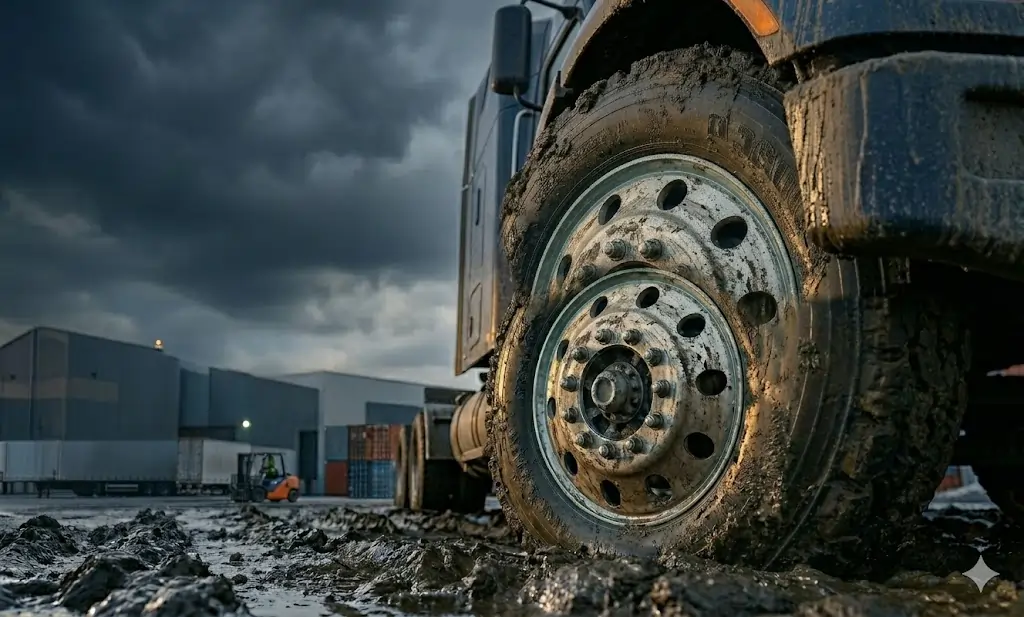
Most people think of being “stuck” as just having no grip. However, for a fully loaded truck, the problem is often stiction (static friction).
When a heavy tire sits in deep, wet mud, the mud wraps around the tire and creates a seal. This seal acts like a giant suction cup.
To beat the “mire factor,” you have to move beyond basic gear. TruckClaws serve as a critical first line of defense.
Instead of placing a loose mat on the ground and hoping for the best, these mechanical tire teeth strap directly to the drive tires. This allows the truck to use its own engine power to “climb” out of the rut.
By using TruckClaws alongside heavy duty winching systems, operators can reduce the stress on the winch’s steel cable or synthetic rope. This combination makes the recovery process much smoother.
It turns a chaotic, dangerous situation into a controlled, professional operation that protects both the driver and the expensive equipment.
To understand why oil field truck recovery is so hard, you have to understand the science of “getting stuck.” When a Class 8 truck drives into deep, wet mud, it doesn’t just lose grip. It becomes part of the ground. This happens because of two things: stiction and the mire factor.
Stiction, or static friction, is a fancy word for the “stickiness” of the mud. When a heavy tire sits in wet soil, the mud wraps around the rubber and creates a tight seal. This seal works like a giant suction cup.
If you have ever tried to pull a boot out of deep mud and felt it tugging back, you have felt stiction in action. Now, imagine that same force acting on a vehicle with a high GVWR (Gross Vehicle Weight Rating).
When a truck is “mired” (buried up to its axles), you can’t just look at the weight on the scale to know how much power you need to pull it out.
Recovery experts use a calculation called the Mire Factor to figure out the total resistance.
The biggest mistake people make in oil field truck recovery is trying to use raw power too early. If you just pull as hard as you can against the suction, you might rip the bumper off or break your rigging hardware.
The secret is to “break the seal” first. You need to let air and water get under the tire to kill the vacuum. This is where TruckClaws are a lifesaver. Because TruckClaws are mechanical tire teeth that sit proud of the tire, they “dig” and “lift” at the same time.
As the wheel turns, the metal bar breaks the mud’s grip and creates a gap. This small gap lets the suction escape, making the truck much lighter and easier to move. Once that “seal” is broken, even a standard hydraulic winch can finish the job with much less stress.
When a Class 8 truck gets stuck, many drivers first reach for plastic boards or rubber mats. These are known as passive traction aids. While they work for cars, they often fail under the extreme GVWR of a heavy truck.
The biggest limitation is that these mats are not attached to the vehicle. Because the truck is so heavy, the spinning tires often “spit” the mats out the back like a projectile.
Even if they stay under the tire, the weight of the truck can simply push a flat board deeper into the soft mud, making the mire factor even worse. In the oil field, where the ground is often slick with oil or deep sludge, these mats just slide around instead of providing a solid surface.
The TruckClaws advantage comes from the fact that they are active traction aids. Instead of laying a tool on the ground and hoping the tire grabs it, you strap TruckClaws directly to the drive tires.
One of the best things about TruckClaws is that you don’t need to predict the future. With many oil field truck recovery tools, you have to put them down before you get stuck. If you are already buried to the axles, it is usually too late to shove a mat under the tire without a bottle jack.
However, you can perform a post-stuck installation with TruckClaws. Even if your tires are halfway underground, you can usually reach the top of the rim to thread the strap through.
You don’t need to dig, and you don’t need to lift the truck. Once they are strapped on, the first half turn of the wheel brings the “claw” into the mud to start the recovery.
As we discussed with stiction, the hardest part of any recovery is the first six inches of movement. This is the initial bite. If you can move the truck just a little bit, you break the mud’s suction and make the rest of the job easy.
TruckClaws are the ideal tool for this first step. They provide the grip needed to “break the seal” of the mud.
Often, this is enough to let the driver drive right out of the hole without needing a tow truck or a hydraulic winch. It saves time, saves money, and keeps the HSE officer happy by using a controlled, safe method.
When it comes to oil field truck recovery tools, most professionals choose hydraulic winches over electric ones. While an electric winch is great for a light Jeep, a heavy Class 8 truck needs a lot more muscle.
A hydraulic winch is powered by the truck’s own systems, like the PTO (Power Take Off) or power steering pump. This allows it to have a continuous duty cycle, meaning it can pull for a long time without overheating.
Electric winches often need to stop and cool down, which is a big problem when a truck is mired in deep mud. Furthermore, hydraulic systems provide the high torque needed to overcome the mire factor and pull a fully loaded trailer through thick sludge.
Sometimes, a slow, steady pull isn’t enough to break the suction of the mud. This is where kinetic recovery ropes, like the famous Bubba Rope, come into play. These are not your average tow straps. They are designed to stretch by 20-30%.
As the recovery vehicle moves away, the rope stretches like a giant rubber band. This stores kinetic energy. When the rope can’t stretch any further, it “pops” back to its original shape.
This sudden, powerful tug helps “pop” the stuck truck out of the mud’s grip. Because the rope is soft and stretchy, it is much safer for the truck’s frame than a stiff steel cable or a choker chain, which can jerk and cause damage.
The best way to save a truck is to use TruckClaws and a winch in a “tandem” or team approach. When you use these two oil field truck recovery tools together, the job becomes much easier for everyone.
In the tight spaces of an oil rig site, you often don’t have a straight line to pull a stuck truck. This is where a snatch block becomes a non-negotiable part of your oil field truck recovery tools.
A snatch block is a heavy duty pulley that allows you to change the direction of your steel cable or synthetic rope.
More importantly, using a snatch block creates a mechanical advantage. By looping the line through the pulley and back to the recovery vehicle, you effectively double the pulling capacity of your hydraulic winch.
If your winch is rated for 20,000 lbs, a snatch block makes it feel like 40,000 lbs. This extra muscle is often exactly what is needed to overcome the mire factor without overworking your equipment.
Safety in the oil field is not just a suggestion; it is the law. HSE officers look for specific markings on all rigging hardware. The gold standard for recovery gear is ASME B30.26. This code ensures that every shackle, hook, and link has been tested to handle extreme industrial loads.
Using “no name” hardware from a local hardware store is a recipe for disaster. If a bolt or a pin fails under the weight of a Class 8 truck, it can snap with enough force to go through a truck cab.
By sticking to ASME rated gear, you ensure that your oil field truck recovery tools are built for the job and won’t fail when the pressure is on.
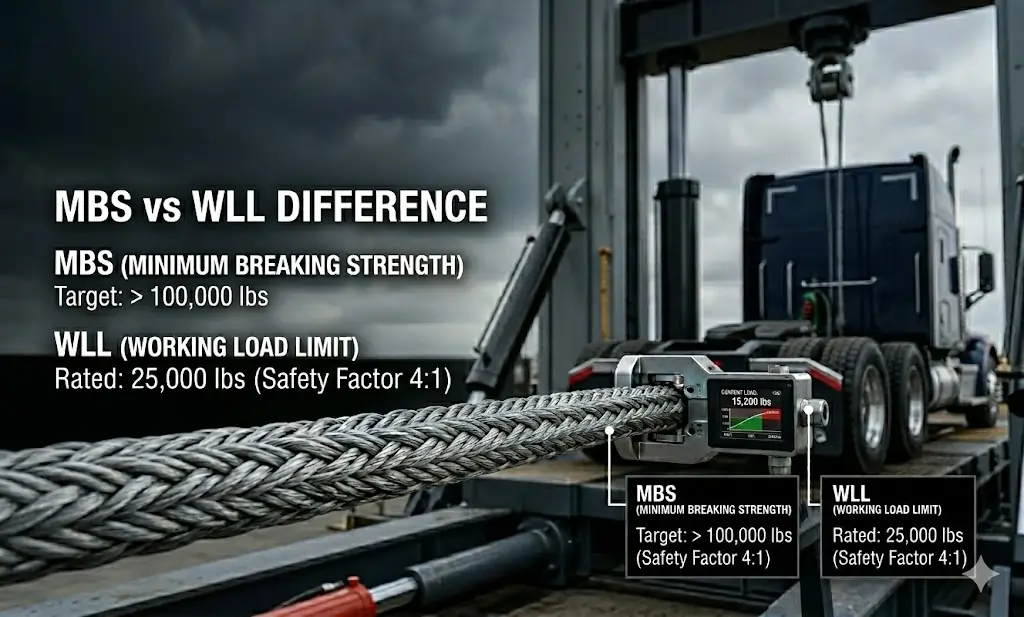
When you buy recovery gear, you will see two different numbers: WLL and MBS. Understanding these is the difference between a safe recovery and a dangerous accident.
For decades, heavy steel D-rings were the only choice for secure connection tools. However, today’s oil fields are moving toward soft shackles made from high capacity synthetic rope.
[Image comparing a traditional steel bow shackle and a synthetic soft shackle]
The reason is simple: safety. If a steel shackle breaks under tension, it becomes a heavy metal “projectile” flying at hundreds of miles per hour.
A soft shackle, on the other hand, is extremely light. If it fails, it simply falls to the ground without the deadly force of a flying piece of steel. They are also much easier to attach to the recovery points on a truck’s frame, especially when your hands are cold or muddy.
In the oil field, a stuck truck is more than just a mechanical problem. It is a safety and environmental risk. This is why every recovery must follow strict HSE protocols (Health, Safety, and Environment).
These rules are in place to protect the driver, the recovery team, and the land itself. When you use professional oil field truck recovery tools, you aren’t just moving a vehicle; you are managing a high stakes work site.
If the mired vehicle is an oil tanker, the job becomes much more complex. A tipped or heavily leaning tanker can leak hazardous fluids into the soil.
Before the big pull starts, the team must set up secondary containment. This involves using spill kits and absorbent “pigs” (long socks that soak up oil) to prevent any spills from spreading.
Furthermore, if the tanker is damaged, vapor recovery systems may be needed to manage volatile gases. In these cases, using TruckClaws is a major advantage.
Because they allow for a smoother, more controlled “climb” out of the mud, there is less jerking and swaying of the trailer. This keeps the cargo stable and reduces the risk of a spill during the extraction process.
Every worker on a recovery site must wear the correct PPE (Personal Protective Equipment). While hard hats and steel toed boots are standard, recovery work requires specific gear for the hands and eyes.
By treating the recovery as a professional operation, using TruckClaws for steady traction and following OSHA safety guidelines. You turn a potential disaster into a successful, clean save.
In the end, a professional oil field truck recovery isn’t just about having one big machine; it is about building a recovery system.
Every tool in your kit has a specific job to do. When you combine raw power with smart mechanical advantage, you turn a potentially dangerous situation into a routine task.
A complete kit for a Class 8 truck should always include:
Whether your fleet operates in the Permian Basin, the Bakken Formation, or the snowy roads of the north, downtime is your biggest enemy. Every minute a truck sits idle in the mud is a minute of lost profit.
TruckClaws are the ultimate “first line of defense” because they are simple, fast, and incredibly effective. They don’t require a second vehicle to pull you out, and they don’t require hours of digging.
By giving your drivers the ability to solve a “stuck” situation on their own, you keep your Class 8 trucks moving and your HSE officers happy.
Don’t wait for a mired truck to halt your production. Equip your fleet with TruckClaws today and turn a major recovery headache into a quick, five minute fix.