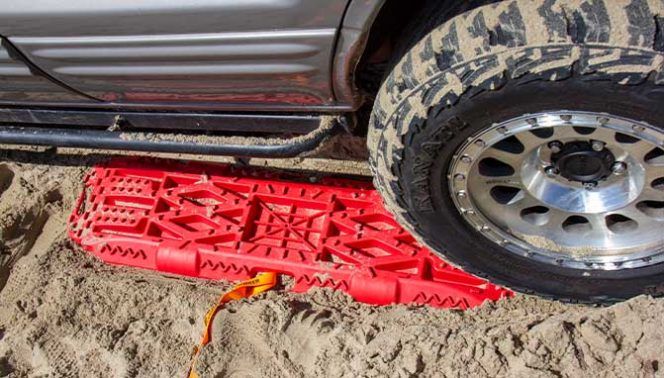
If your RV is stuck in the mud, don’t panic. The best way to get a heavy vehicle moving again is to increase the surface area of your tires or use a mechanical tool like TruckClaws to “bite” into solid ground.
Most people can get themselves out by using a combination of digging, lowering tire pressure, and using a heavy duty recovery tool.
While many travelers think they can just wait for a tow truck, RV stuck in mud recovery is often something you can handle on your own.
In fact, learning how to use self recovery gear for large vehicles can save you a lot of time and money. Having a plan before you get stuck is the secret to stress free camping.
The Nightmare of an RV Stuck in Mud: Why Saturated Soil is the Enemy
The Sinking Reality
Imagine waking up in a beautiful forest, only to find that a night of rain turned the grass into a swamp. This happens because of ground saturation. When the soil gets too much water, it loses its strength.
Because campervans and motorhomes are so heavy, they can sink into the saturated soil in just a few minutes. What looked like a solid parking spot yesterday can quickly become a mud trap today.
The GVWR Problem
Every motorhome has something called a Gross Vehicle Weight Rating (GVWR). This is just a fancy name for the total weight of your rig when it is full of water, fuel, and gear. Because Class
A motorhomes are so massive, all that weight pushes down on the tires in a very small area. This is called “point loading.” When all that pressure hits soft mud, the tires sink like a rock in a pond. Even all terrain tires can struggle when the weight of the vehicle is pushing them deeper into the muck.
The Cost of Getting Stuck
Waiting for help can be the worst part of your trip. A professional RV extraction service can be very expensive. In 2026, a simple “winch out” in a remote area can easily cost $450 or more. Even if you have RV emergency roadside assistance, it might take many hours for a big enough tow truck to reach you.
This wait can ruin your travel schedule and leave you stranded in the heat or cold. This is why many smart travelers carry TruckClaws, so they can pull themselves out and get back to their vacation without waiting for anyone else.
First Steps for Motorhome Breakdown Recovery in Mud (Before You Tow)
Before you pick up the phone to call for help, there are a few things you can do to help your motorhome help itself. Most motorhome breakdown recovery starts with making your tires work better with the ground you have.
The Air Down Technique: Increasing Your Tire Footprint
One of the best tricks is to lower your tire pressure. This is often called “airing down.”
Lowering PSI: When you let some air out of your tires, the bottom of the tire flattens out. This makes the tire footprint expansion much larger. By lowering your PSI (Pounds per Square Inch), your tire sits on top of the mud rather than cutting into it. This gives you better “flotation” on saturated soil. Just be sure you have an air compressor to pump them back up once you reach a hard road!
Weight Distribution Strategy: Here is a smart campervan mud traction hack. If you have a front wheel drive (FWD) van, move heavy things like water jugs or luggage to the front seats. If your van is rear wheel drive (RWD), move that weight to the back. Putting more weight directly over the drive axle helps the tires push harder against the ground for better grip.
Lifting the Rig: Bottle Jacks and Hydraulic Levelers
Sometimes, your RV is so deep that the mud is acting like a vacuum, sucking your tires down. You need to break that suction before you can move.
Beating the Suction: If your tires are buried, trying to drive out will only make the hole deeper. You should use a bottle jack or your RV’s built in hydraulic leveling jacks to lift the vehicle up. Once the tire is out of the rut, it is much easier to slide TruckClaws or other aids underneath.
Safety First: Never put a jack directly on soft mud, or the jack will just sink instead of lifting the RV! Always place a wide, thick wood block or a “jack pad” under the jack first. This spreads the weight so you can lift the rig safely. Once the tire is raised, you have a much better chance of a successful self recovery for large vehicles.
Best Mud Mats for Heavy RVs 2026: Why TruckClaws Outperform Plastic
When you search for best mud mats for heavy RVs 2026, you will see a lot of bright plastic boards. While these might work for a light car, heavy vehicles need something much tougher. Choosing the wrong tool can lead to broken gear and a very long walk for help.
The Failure of Standard Traction Boards for Large Vehicles
Many people buy plastic boards because they are light and look cool. However, they often fail when used with a big rig.
The “Spin and Melt” Issue: Modern Class A motorhomes and diesel campers have incredible instant torque. When you step on the gas, the wheels spin with massive power. This creates friction heat that can actually melt the plastic nubs on a mat. Once those nubs are gone, the board becomes a slippery slide, and your tire tread depth has nothing to grab. Many plastic boards even come with a warning: “No warranty for melted boards.”
The “Already Buried” Dilemma: To use a 4 foot plastic board, you have to dig a long ramp in the mud and shove the board under the tire. This is very hard work if your campervan is already deep in a rut. If you can’t get the board deep enough, the tire will just spit it out like a projectile.
This is where TruckClaws change the game. Instead of laying something on the ground and hoping it stays there, you attach the grip directly to the tire.
The Metal “Bite”:TruckClaws are made of high grade carbon steel or aircraft grade aluminum. They act like a heavy duty paddle that you strap to your tire with a high strength 16,000 LB rated strap. Because they are metal, they won’t melt or snap under the weight of a 30,000 pound RV. They mechanically lift the tire out of the hole, turning your wheel into a gear that “walks” out of the mud.
Dual Rear Wheel (DRW) and SAE Class S Clearance: Many large RVs have Dual Rear Wheels (DRW), which means two tires sit side by side. Most traction mats are too wide to work well here. TruckClaws are designed to fit perfectly on these commercial style wheels. They also work with SAE Class S clearance, meaning they won’t hit your ABS sensors or brake lines. You only need about 2.5 inches of space for them to work safely, making them the most versatile self recovery gear for any rig.
External Help: Tractors vs. Heavy Vehicle Winch Out Service
Sometimes, even with the best tools, you might decide to call for outside help. This is common when your rig is truly “buried” or if you are in a remote area. However, you must be very careful when an external vehicle tries to pull your heavy RV.
The “Farmer with a Tractor” Warning
If you are boondocking and get stuck, a friendly local farmer might offer to pull you out with their tractor. While this is a kind gesture, it can be dangerous for your vehicle if done incorrectly.
Protecting Your Chassis Frame: Never allow anyone to attach a rope or chain to your RV’s bumper. Most modern RV bumpers are “aesthetic,” meaning they are just for looks and are not strong. A powerful tractor pull will rip the bumper right off! You must ensure they attach only to the chassis frame or a rated recovery point.
Proper Gear: Many farmers use heavy metal chains, but these can be dangerous. If a chain snaps, it flies like a bullet. Instead, it is much safer to use kinetic snatch straps or kinetic recovery ropes. These are made of stretchy nylon that acts like a giant rubber band. They provide a smooth pull and are less likely to bend your frame. Using soft shackles instead of steel ones also makes the recovery much safer for everyone.
RV Emergency Roadside Assistance (Spain, Europe, and North America)
If you are traveling in 2026, you likely have a roadside assistance plan. But did you know that different countries have different clubs?
Navigating Foreign Recoveries: If you are “Van lifing” through Europe, you should know the local names for help. In Spain, the main clubs are RACE or RACC. In Germany and much of Europe, the ADAC is the most famous. In North America, Good Sam is often better than AAA because they specialize in heavy vehicle winch out service.
The “Dead Zone” Tip: If you are stuck in a remote mountain area with no cell service, remember that modern 2026 phones often have Satellite SOS. You can use this to text your location to emergency services even without 5G.
Spanish Emergency Phrases: A Quick Cheat Sheet
If you are stuck in a remote part of Spain and need to call for a tow, keep these phrases on your phone:
“Estoy atascado en el barro”, I am stuck in the mud.
“Necesito una grúa para una autocaravana”, I need a tow truck for a motorhome.
“¿Cuánto cuesta el servicio de rescate?”, How much does the rescue service cost?
“¡Ayuda, por favor!”, Help, please!
Prevention: How to Avoid Needing RV Extraction Services
Getting stuck is stressful, so the best strategy is to avoid the mud entirely. With a few simple habits, you can keep your 2026 travels smooth and stay away from expensive RV extraction services.
Walking the Ground: The Golden Rule
Before you drive your heavy rig onto any grass or dirt, follow the “Golden Rule” of off grid camping: always walk the ground first.
Because an RV can weigh over 15,000 lbs, it puts much more pressure on the soil than your feet do. As you walk, pay attention to how the ground feels. If your boots sink or if the ground feels “spongy,” your RV will almost certainly get stuck.
In 2026, many experienced travelers also use a simple stick to poke the mud. If the stick goes in easily, it is a sign of high ground saturation, and you should find a harder place to park.
Choose Your Pitch Wisely
If you are at a campsite, try to pick a “hardstanding” pitch made of gravel or concrete. If you must park on grass, try to keep your drive axle as close to the solid road as possible. This way, if you do start to slip, your tires only have to move a few inches to find grip.
The “Plan B” Checklist
Even the most careful drivers can get stuck. Keeping a small “Recovery Kit” in your storage bay is the best insurance policy you can have. Here is what every RV should carry in 2026:
A Sturdy Shovel: To clear mud from around your tires and break the suction of the ruts.
A Portable Air Compressor: Essential for the air down technique. You need this to pump your tires back up to the correct PSI before hitting the highway.
A Set of TruckClaws: These are your secret weapon. Because they are compact, they won’t take up much space, but they provide the metal “bite” needed to move a heavy Class A motorhome when plastic mats fail.
Wood Blocks: To give your bottle jack a solid base so it doesn’t sink while you are trying to lift the rig.
Kinetic Snatch Strap: Just in case a friendly neighbor offers a pull, this strap will protect your chassis frame from a sudden, jerky tug.
By following these tips and keeping your gear ready, you can enjoy your adventures knowing you have everything you need to stay moving!
Manage Consent
We use cookies to optimize our website and our service.
Functional cookies
Always active
The technical storage or access is strictly necessary for the legitimate purpose of enabling the use of a specific service explicitly requested by the subscriber or user, or for the sole purpose of carrying out the transmission of a communication over an electronic communications network.
Preferences
The technical storage or access is necessary for the legitimate purpose of storing preferences that are not requested by the subscriber or user.
Statistics
The technical storage or access that is used exclusively for statistical purposes.The technical storage or access that is used exclusively for anonymous statistical purposes. Without a subpoena, voluntary compliance on the part of your Internet Service Provider, or additional records from a third party, information stored or retrieved for this purpose alone cannot usually be used to identify you.
Marketing
The technical storage or access is required to create user profiles to send advertising, or to track the user on a website or across several websites for similar marketing purposes.