Do Tire Traction Aids Work? Real-World Testing and Top Picks
If you are wondering if tire traction aids actually work, the short answer is yes. These tools are like an insurance policy for your vehicle.
Whether you are driving through a surprise snowstorm or find yourself stuck in deep mud while off-roading, a good traction aid can be the difference between driving home and being stranded.
They work by giving your tires a rough surface to “bite” into when the ground is too slippery for rubber alone.
However, not every tool works for every situation. You must match the right gear to your specific problem.
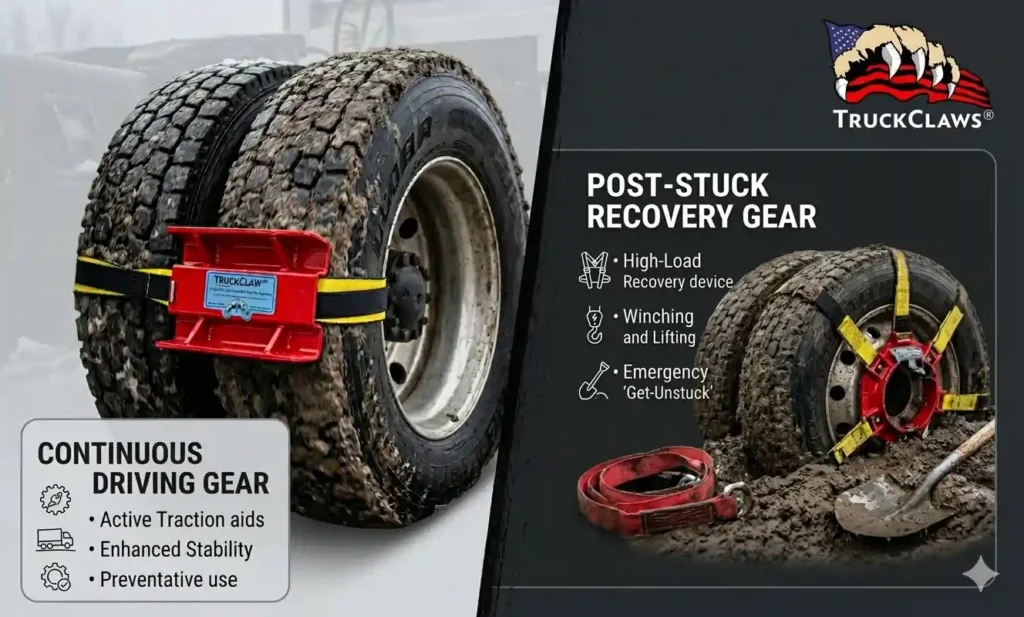
For example, while some tools help you drive for miles on an icy road, others—like TruckClaws—are designed specifically to pull you out of a hole once you are already stuck.
Having these emergency vehicle recovery tools in your trunk is the best “Plan B” for anyone who drives in tough conditions.
The Verdict: Your Essential “Plan B”
In 2026, winter driving safety is more important than ever because weather can change in an instant. Most experts agree that while winter-rated compounds in tires are great, they have limits. When those limits are reached, traction aids take over.
They are essential because they help you stay in control during off-road recovery and keep you moving when the road turns into a skating rink. Plus, using your own gear is much faster than waiting hours for help.
The Friction Factor: Why Tires Lose the Battle
To understand why we get stuck, we have to look at the coefficient of friction. This is just a fancy way of saying how “sticky” two surfaces are to each other.
On a dry road, your tire tread depth works perfectly to grip the pavement. But when you add thick ice, deep mud, or loose sand, that “stickiness” disappears.
Your tires start to spin because they can’t find anything solid to grab. This wheel spin creates heat, which can actually make mud or snow even more slippery.
TruckClaws and other heavy-duty aids solve this by adding a mechanical “tooth” to your wheel. Instead of just rubbing against the slippery surface, the tool digs deep to find solid ground and pushes the vehicle forward.
Saving Money on Recovery Fees
Think of a traction aid as a way to save your wallet. In 2026, roadside assistance and rural tow truck fees have jumped to over $450 in many areas. If you are far away from a city, that price can go even higher. Investing in a set of TruckClaws costs much less than a single tow. By carrying your own self-recovery gear, you save money and avoid the stress of being stuck in the middle of nowhere.
Categorizing Your Gear: Continuous Driving vs. Post-Stuck Recovery
When you look for tools to help your tires, you will find two main types. One type is for continuous driving, which helps you keep moving on a long, snowy road.
The other type is for post-stuck recovery, which is what you use after your vehicle has already stopped moving and is buried in a hole. Knowing the difference helps you pick the right tool for the job.
Proactive Tools for Moving on Packed Snow and Ice
If you know the road ahead is covered in ice, you need a “proactive” tool. These are tools you put on before you get into trouble.
Traditional Tire Chains: These are often called the gold standard for driving on highways in mountain passes. They are made of strong metal loops that wrap around your tire. They are great for driving long distances on hard-packed snow, but they can be very heavy and loud.
Snow Socks vs. Chains: In 2026, many people with smaller cars use snow socks. These are fabric covers that slip over the tire. They are perfect for light urban snow and cars with very little space around the wheel, known as SAE Class S clearance. While they are easy to put on, they aren’t as strong as metal chains.
The Big Limitation: The problem with chains and socks is that you usually need to be able to move your car to put them on. If you are already axle-deep in mud, it is almost impossible to wrap a chain around your tire.
“Reactive” tools are for emergencies. These are the tools that save you when you are already stuck and can’t move an inch.
The “Biting” Advantage: Unlike mats that you lay on the ground, TruckClaws strap directly onto your tire. They act like a big mechanical paddle. As your tire turns, the TruckClaws dig into the ground and “bite” the dirt or snow. This lifts the tire up and pushes the truck forward.
TruckClaws vs. Traction Mats: Many people use plastic traction mats, but these have a weakness. In deep clay or mud, a heavy truck can actually spit the mat out behind the tire like a slippery banana peel. This is especially true for modern trucks with high-torque engines that spin the wheels with a lot of power. Because TruckClaws are locked to the wheel, they can’t slip away.
Self-Recovery Gear for Trucks: Having these tools means you don’t need to wait for a second vehicle to pull you out with a kinetic recovery rope. You can regain control all by yourself, which is the safest way to travel when you are off the main road.
Best Tire Traction Aids for Heavy-Duty and Commercial Trucks
When you are driving a large truck or a commercial van, you carry much more weight than a normal car.
This extra weight means you need stronger tools. In 2026, many drivers are switching to heavier electric vehicles (EVs) and powerful modern diesels, which makes choosing the right emergency vehicle recovery tools even more important.
Heavy-Duty Performance: Why TruckClaws are the Top Choice for Fleets
For people who drive for a living, a tool must work every single time, no matter the weather.
Durability in Sub-Zero Temps: When it gets extremely cold, plastic can become “brittle.” This means it gets stiff and can crack or snap like a dry cracker. TruckClaws use high-grade carbon steel or aircraft-grade aluminum. These metals stay strong in freezing weather, so you don’t have to worry about your tools breaking when you need them most.
Storage & Portability: Space is very important in a truck cab or a delivery van. Traction boards are often 4 feet long and very bulky, making them hard to hide away. TruckClaws are much smaller and come in a compact bag. This space-saving design makes them much easier to store behind a seat or in a small toolbox compared to large traction mats.
Handling High-Torque Recovery in EVs and Modern Diesels
Newer trucks have a lot of “instant torque.” This means the wheels can spin with a huge amount of power the second you touch the pedal.
The “Spin and Melt” Warning: If you use plastic traction mats with a high-torque truck, the spinning tire creates a lot of heat. This heat can actually melt the plastic nubs on the mat, making it smooth and useless. This is why TruckClaws’ carbon steel construction is so important. Metal doesn’t melt like plastic, so it stays strong and keeps its grip even when your engine is working hard.
GVWR Considerations: Every truck has a Gross Vehicle Weight Rating (GVWR), which is the total weight it can safely carry. For fleet maintenance, you must pick a traction aid that can handle that specific weight. While plastic boards might snap under a fully loaded 18-wheeler, TruckClaws are built for heavy-duty specs and won’t break under pressure.
Factors for Success: When Traction Aids Fail
Even with the best gear, there are times when your tires still won’t move. Knowing why this happens can save you a lot of frustration and help you get back on the road faster.
The High-Centering Reality and Ground Clearance
The most common reason emergency vehicle recovery tools fail is something called “high-centering.” This happens when the ground clearance under your truck is gone.
The “Belly” Problem: If you drive into a deep snowdrift or a mud hole and the bottom of your truck (the “belly”) touches the ground, your tires will just hang in the air. In this case, no amount of grip from TruckClaws or chains will help because the tires aren’t pressing down hard enough. You must first use a shovel to clear the path under the truck so the weight rests back on the tires.
Wheel-Well Clearance: Modern trucks and Electric Vehicles (EVs) have very little space between the tire and the body of the car. This is often called SAE Class S clearance. Before you install any aid, make sure it won’t hit your ABS sensors or brake lines. TruckClaws are designed to stay tight to the tire, which helps keep these sensitive parts safe from damage.
Driver Technique: Static vs. Kinetic Friction
How you drive matters just as much as what you use. There is a big difference between static friction (grip when the tire is rolling) and kinetic friction (sliding when the tire is spinning).
The “No-Spin” Rule: When you get stuck, your first instinct is to floor the gas pedal. This is a mistake! Excessive wheel spin turns snow into ice and mud into a slippery soup. This sliding motion—or kinetic friction—actually has less grip than a tire that is barely moving. To get the most out of TruckClaws, use a very gentle touch on the gas. Let the metal “teeth” find their own grip.
Preserving Your Gear: Spinning your tires fast while using an aid can also damage your tire tread depth or break your tools. Slow and steady is the secret to a successful off-road recovery.
The Air-Down Technique: Maximum Footprint
One of the best tricks used by pros is “airing down.” This means letting a little bit of air out of your tires to lower the tire pressure (PSI).
When you lower the pressure, the tire flattens out a bit. This creates a much larger contact patch, which means more rubber is touching the ground.
When you combine this “bigger footprint” with the mechanical grip of TruckClaws, you get the maximum amount of traction possible. Just remember to use a portable air compressor to fill your tires back up before you hit the highway!
Know Before You Go: Legal and Maintenance Tips
Even the best emergency vehicle recovery tools won’t help you if you are not allowed to use the road or if your gear breaks because of poor care. In 2026, many states have updated their rules for winter driving to keep everyone safe.
Chain Laws 2026: Staying Legal in the Mountains
Before you head into the mountains, you must understand the “Carry Laws.” In states like California and Colorado, Department of Transportation (DOT) officers often set up checkpoints during storms.
Mandatory Carry: Even if the sun is shining, many mountain passes require you to have traction aids inside your vehicle from September through May. If you get caught without them, you could face a fine of over $130.
The Activation Sign: When you see signs for Passenger Vehicle Traction Law or “Chains Required,” you must pull over and install your gear. In Colorado, if you get stuck and block a highway because you didn’t have the right tools, the fine can jump to over $650!
AWD is Not Enough: Many people think 4WD/AWD means they are exempt. However, during a “Level 3” storm, every vehicle must have chains or an approved aid like TruckClaws to proceed.
Corrosion Control: Keep Your Gear from Rusting
In the winter, cities spread road salt (sodium chloride) or liquid magnesium chloride to melt ice. While this helps with traction, it is very “aggressive” on metal.
The Post-Recovery Rinse: Salt speeds up a chemical reaction that creates rust. After you use your TruckClaws or metal chains, do not just throw them back in the bag while they are wet.
Maintenance Tip: Once you get home, rinse your gear with fresh water to remove the salt. Dry them completely with a towel before storing them. For extra protection, you can spray a little bit of lubricant on the metal parts to keep them moving smoothly for years.
The Cost Comparison: Tool vs. Tow
Is it worth buying your own gear? Let’s look at the average costs for 2026:
Service / Tool
Estimated Cost (USD)
Benefit
TruckClaws II (Light Truck Kit)
$150 – $200
One-time buy; works forever; no waiting.
Professional Tow (Rural/Off-Road)
$450 – $800+
Very expensive; can take hours to arrive.
Winching Service (Getting “Unstuck”)
$150 – $300
Only covers the pull; doesn’t help you later.
State Fine (Non-Compliance)
$130 – $650
Wasted money that doesn’t help you get home.
As you can see, having TruckClaws in your truck is much cheaper than calling for help just one time. It is the smartest way to ensure winter driving safety without breaking the bank.