
The best way to handle a stuck truck in a muddy yard is to avoid the tow truck entirely by using a tiered plan for logistics yard mud solutions.
In 2026, smart fleet managers use a mix of permanent ground protection and portable heavy-duty recovery tools like TruckClaws Commercial.
These tools allow drivers to get themselves moving again in minutes rather than hours, keeping the supply chain moving smoothly.
When a Class 8 heavy hauler gets stuck, it is not just a small mistake—it is a financial emergency. Waiting for a professional wrecker can lead to massive winch-out fees that often start at $1,500.
Furthermore, every minute a truck sits idle, it eats into the driver’s ELD Hours of Service, which can ruin an entire week’s delivery schedule. By prioritizing self-recovery, companies save money and keep their drivers on the road.
In the fast-paced world of 2026 logistics, mud is much more than just a mess; it is a “budget killer.” When a big rig sinks into a soft spot in the yard, the clock starts ticking immediately.
A simple two-hour delay can lead to missed delivery windows, which might result in heavy late fees from unhappy clients. Because of these fleet immobilization costs, having a fast way to get moving is essential for any successful business.
The costs of getting stuck go far beyond the tow bill. For example, a driver waiting for a tow truck is “burning” valuable time on their Electronic Logging Device (ELD).
If they run out of legal driving hours while waiting for a pull, the truck might have to sit overnight, doubling the delay. This is why self-recovery gear like TruckClaws is so important. It acts like an insurance policy for your schedule, turning a major crisis into a minor 15-minute fix.
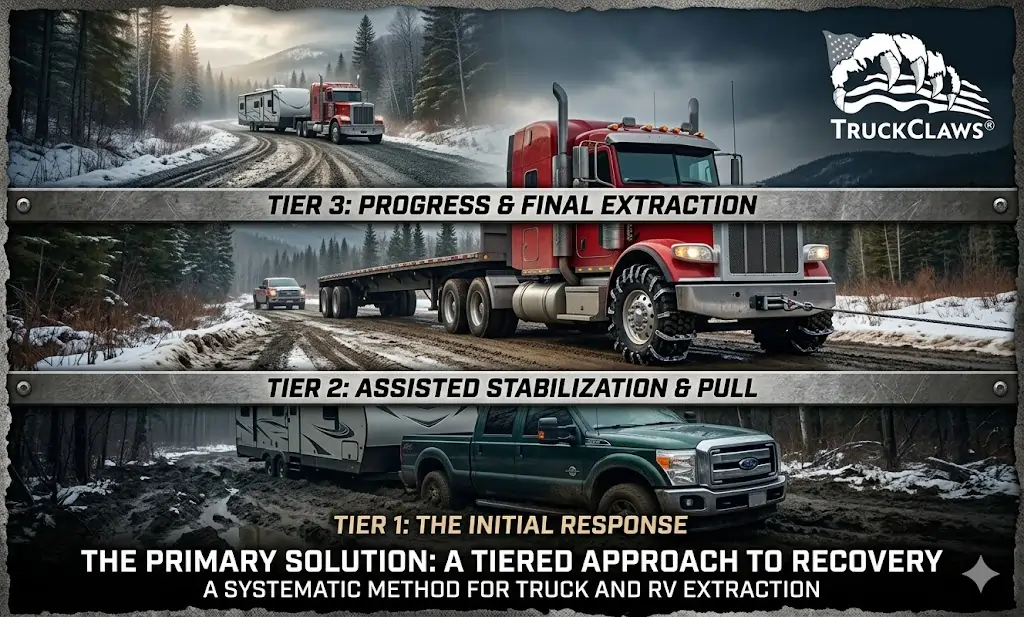
To keep a yard running well, you need more than one tool. A great logistics yard mud solution starts with ground protection mats in high-traffic areas to stop ruts before they start. However, since you cannot pave the whole world, you also need a “Plan B.”
This is where tire-mounted traction aids come into play. Keeping a set of TruckClaws Commercial in the cab of every truck ensures that if a driver hits an unmapped mud hole, they have a professional way to “bite” into the ground and climb out.
Because these commercial truck traction aids are made of high-strength materials, they can handle the massive drive axle torque of a semi-truck without breaking.
Beyond the money, muddy yards bring serious legal problems. Many cities now have strict track-out laws. These laws mean that if your trucks drag mud out of your yard and onto public highways, your company could face huge fines for water pollution or road hazards.
Using mud mats and quick extraction tools helps keep the tires clean and the local government happy.
Finally, we must think about OSHA safety standards. A muddy, slippery yard is a prime spot for slip-and-fall accidents. When a driver has the right tools to get unstuck quickly, they spend less time walking around in dangerous, slippery conditions.
By using the right heavy-duty recovery tools, you are not just protecting your trucks; you are protecting your people.
When a heavy truck enters a muddy logistics yard, it often faces a “slurry” of wet soil. Unlike thick mud, this slurry acts like a lubricant.
Standard tires fail here because the small gaps in the tire tread fill up with wet mud instantly, turning the tire into a smooth, spinning slick. Without a way to push against the ground, the truck simply sinks deeper into mud ruts, causing a major delay.
While many drivers carry plastic recovery boards, these are often not enough for GVW Class 7 & 8 trucks.
A semi-truck can weigh over 30,000 lbs, which is enough to crack or flatten a plastic board. TruckClaws Commercial is the “Gold Standard” because it is made of heavy-duty steel designed to handle extreme weight.
Unlike boards that can slide out from under the tire or “shoot” away like a projectile when the wheels spin, TruckClaws stay attached to the wheel. This provides a constant, reliable tire-mounted traction aid that works every time the axle turns.
The biggest problem with traction mats or boards is that you have to dig a path to slide them under the tire. If your truck is already buried deep in a mud hole, this means the driver has to spend an hour digging in the cold.
With TruckClaws, you have a massive advantage: you do not need to dig. Since they strap through the holes in your alloy rims, you can install them even if the bottom of your tire is completely hidden in the mud. You simply attach them to the part of the tire that is still visible, and you are ready to climb out.
The secret to why these tools work so well is the “Paddle Effect.” Think of how a paddle boat moves through the water. The steel bar on the TruckClaws acts like a paddle for your tire. It digs deep into the soft ground and “bites” into the firmer soil underneath.
Because the system uses high-tensile straps and heavy-duty ratchets, it can withstand the incredible drive axle torque that a semi-truck produces.
While a cheap nylon snow tie would snap under this pressure, these commercial-grade straps hold firm. They allow the truck to use its own engine power to lift itself up and out of the mud, saving you from a costly winch-out fee.
While extraction tools help you get out of a mess, the best logistics yard mud solution is to stop the mess from ever starting. For areas where trucks drive every single day, smart managers use “Prevention First” tactics.
The most effective way to prevent a yard from turning into a swamp is to lay down ground protection mats. Think of these as a temporary, “floating” roadway. These mats are usually made from High-Density Polyethylene (HDPE) or other composite materials that are incredibly strong but flexible.
When you place these mats in loading zones or entryways, you create a level, stable surface. This keeps your Class 8 heavy haulers and delivery vans on top of the mud instead of sinking into it. Because these mats are vibration-free and slip-resistant, they also make the yard much safer for workers who need to walk between vehicles.
To understand why mats work, we have to look at PSI (Pounds per Square Inch). A heavy semi-truck puts a massive amount of “ground pressure” on a very small area where the tires touch the dirt. This high pressure is what causes the soil to displace, creating deep mud ruts.
Ground protection mats change the physics of the load. They take that heavy weight and spread it out over a much larger surface area.
In a busy logistics hub, you often have a mix of vehicles, from small vans to heavy equipment over 100 tons. Using a tiered system gives you the best protection:
By combining the “floating floor” of the mats with the “mechanical bite” of TruckClaws, you ensure that no matter where a driver goes in the yard, they have the right heavy-duty recovery tools to stay on schedule.
This dual-layer strategy is the most cost-effective way to manage vehicle immobilization costs and keep your fleet moving.
Even with the best heavy-duty recovery tools, knowing the right techniques can make a huge difference. These professional methods help you use your truck’s power correctly so you can escape the mud without causing damage.
One of the oldest tricks in the book is “airing down” your tires. When you reduce your PSI (Pounds per Square Inch) to about 15–20, the bottom of your tire flattens out. This creates a much larger “footprint” on the ground.
Mud can sometimes act like a giant vacuum, pulling down on the chassis of your truck. This is called the “suction” effect. To break it, professional drivers use the “Rocking” technique.
Once you are out of the mud, the job isn’t quite finished. Mud is full of moisture and chemicals that can cause serious long-term maintenance costs.
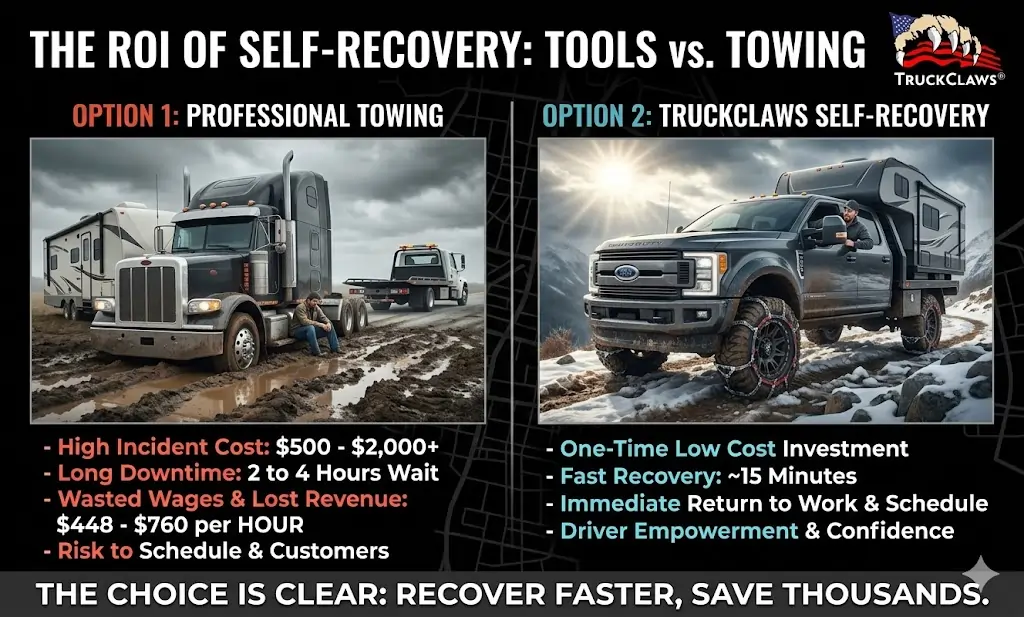
In the logistics industry, “Time is Money” is more than just a saying—it is a mathematical fact. When you compare the cost of professional towing to the cost of owning self-recovery gear, the choice becomes very clear.
If you don’t have the right tools in your cab, a single mud hole can become an expensive disaster. Here is what the average costs look like this year:
The biggest saving isn’t actually the tow bill—it is the time. In 2026, unplanned downtime is estimated to cost fleets between $448 and $760 per hour when you factor in lost revenue and driver pay.
Running a muddy yard in 2026 also brings several “hidden” risks that can hurt your company’s reputation and bank account.
Many local governments have passed strict track-out laws to protect the environment. If your trucks drag mud out of the yard and onto public streets, it can wash into storm drains and cause water pollution.
Safety is the number one priority for any fleet manager. Muddy yards are a primary spot for slip-and-fall injuries, which are a major concern for OSHA safety standards.
Every minute counts on a driver’s Electronic Logging Device (ELD). Under 2026 Hours of Service (HOS) rules, a driver only has a limited “window” of time to complete their deliveries.
To succeed in 2026, you must have a plan for bad weather. A mud-resilient logistics hub isn’t built by accident; it is built through smart choices.
Final Thought: In the world of logistics, you aren’t just buying a traction tool; you are buying operational discipline. By investing in the right heavy-duty recovery tools, you protect your profits, your schedule, and your drivers.