
A heavy truck does not always sink because it weighs more. A lighter truck does not always float because it weighs less. The real issue is how much weight each tire pushes into the ground. That is why tire ground pressure truck physics matters so much when you drive through mud, sand, snow, wet grass, or soft jobsite soil.
A 6,000 lb pickup can sink into wet sand while a tracked construction machine crosses the same surface with less trouble. The difference comes down to ground pressure: the pounds per square inch each tire, track, or traction point puts on the surface below it.
Once you understand that one idea, stuck truck recovery starts to make more sense. Tire pressure, contact patch size, vehicle weight per tire, spinning wheels, and recovery tools all connect to the same problem: can the ground hold the load, or will the tire break through?
Ground pressure is the load your vehicle puts on the ground through the part of the tire that is actually touching the surface. That area is called the contact patch.
Take a 6,000 lb pickup as an example. The weight is split between four tires, but not perfectly evenly. Many empty pickups carry more weight over the front axle because the engine sits up front. A common rough split is about 55% front and 45% rear.
That means each front tire may carry around 1,650 lbs, while each rear tire may carry around 1,350 lbs.
Now look at the contact patch. If one front tire is carrying 1,650 lbs and the contact patch is about 36 square inches, the ground under that tire is feeling roughly 46 PSI.
That number matters.
If the soil can support more than that pressure, the tire stays on top. If the soil cannot support it, the tire starts to sink.
Hard packed dirt can often hold much more weight than wet clay or saturated sand. Dry ground may support the truck well. The same truck on soft mud may break through almost immediately. The truck did not change. The surface did.
Tracked machines spread their weight over a much larger area.
A tracked loader or dozer may weigh many times more than a pickup, but its tracks create a much larger footprint. Instead of putting all that weight through four small tire patches, the machine spreads the load across long tracks.
That lowers the pressure on each square inch of ground.
This is why a tracked machine can cross soft soil that stops a pickup. The machine may weigh far more, but the ground feels less pressure per square inch.
For truck drivers, the lesson is simple: the contact patch matters as much as the weight. Anything that increases the area touching the ground can reduce ground pressure. That includes airing down, wider tires, and certain recovery tools.
Most drivers think about total vehicle weight. In recovery, vehicle weight per tire is often more useful.
A 6,000 lb truck is not pushing 6,000 lbs through one tire when it is rolling normally. The weight is spread across four tires. But when one drive tire loses grip and starts spinning, the recovery problem changes.
In a 2WD pickup, one rear tire may be doing almost all the work. In a 4WD truck with open differentials, power can still go to the wheel with the least resistance, often the wheel sitting in the rut.
That means the truck may have four tires on the ground, but only one tire is trying to move the vehicle.
When that tire spins, it digs. As it digs, the contact patch gets worse. The tire is no longer sitting flat on the surface. It is sitting in a hole. The soil around it has been broken up. Mud turns into slurry. Sand collapses. Snow packs and polishes.
The longer the wheel spins, the worse the math gets.
A short spin may still leave the truck recoverable with a small traction change. A long spin can bury the tire to the axle and put the frame closer to the ground.
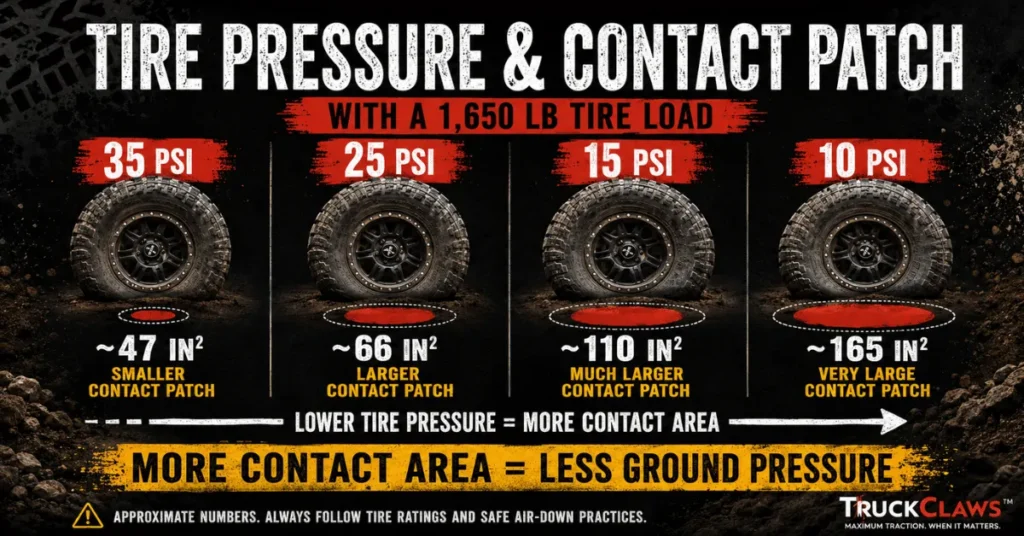
Lowering tire pressure increases the tire’s contact patch. That is why airing down helps on sand, snow, and some soft trails.
Here is the simple version:
A tire carrying 1,650 lbs at 35 PSI has a smaller contact patch than the same tire at 20 PSI or 15 PSI. As pressure drops, more rubber touches the ground. More contact area means less pressure on each square inch of soil.
Example:
The exact numbers change by tire size, sidewall stiffness, wheel setup, and load. The point stays the same: lower tire pressure spreads the load over more ground.
That can help the truck stay on top of soft surfaces instead of cutting through them.
Before you air down, check your tire markings and ratings so you know what your tires are built to handle. Do not guess with tire pressure, especially when the truck is loaded.
Airing down works best before the truck breaks through the surface.
Once a tire is buried in a rut, lowering pressure may not fix the problem. The tire is already sitting low. The ground around it has already been disturbed. The contact patch is no longer working against a flat surface.
That does not mean airing down is useless after getting stuck, but it is much less powerful than airing down before entering soft ground.
If you know you are about to drive onto sand, deep snow, wet clay, or soft grass, lower pressure before the truck starts digging. That gives the tire a better chance to float from the start.
Spinning tires feel like action, but they usually make the recovery worse.
When the tire spins without moving the truck, it removes material from under the tread. Mud gets thrown backward. Sand gets pushed out of the hole. Snow packs, melts, and hardens. Wet grass tears away and leaves slick soil underneath.
The truck then drops lower.
Once the tire drops, the axle and frame get closer to the surface. If the frame starts touching the ground, the tires are no longer carrying the full vehicle weight the way they should. At that point, you are not just fighting for traction. You are fighting the weight of the truck sitting on the ground.
That is why the first rule of stuck truck physics is simple:
Stop spinning early.
A five second mistake is usually easier to fix than a one minute mistake.
Dual rear wheels are great for carrying load on pavement. They are not always great on soft ground.
A dually spreads load across more tires, but those tires are narrower and often run higher pressure. On soft soil, the two rear tires on each side can cut two separate ruts instead of one wider track.
Once both rear tires sink, the truck has more rolling resistance and more sidewall drag. Mud can pack between the duals. Wet grass can peel away under both tires. Sand can collapse around each narrow contact patch.
This is one reason RVs, service trucks, and commercial pickups with dual rear wheels can get stuck faster than drivers expect.
The issue is not only weight. It is how that weight reaches the ground.
The phrase truck physics stuck sounds technical, but the real idea is simple: a truck gets stuck when the drive tire cannot create enough grip to overcome the resistance around it.
That resistance can come from:
A truck does not need all four tires to lose grip. One badly placed drive tire can be enough.
That is why recovery starts with reading the tire and the ground. Which tire is spinning? Which tire has the best surface under it? Is the truck sitting on the frame? Is the easiest exit forward, backward, or slightly sideways?
The answer changes the recovery plan.
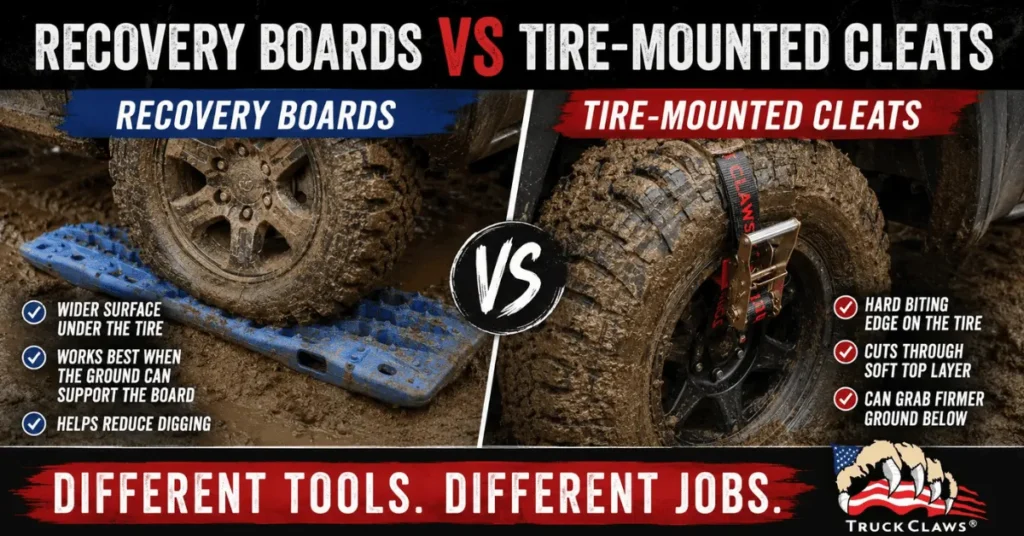
Recovery boards and tire mounted cleats solve the problem in different ways.
A recovery board spreads the tire’s force over a wider surface. The board gives the tire something to climb onto and helps stop the surface from collapsing directly under the tread.
That works well when the ground can support the board and the tire together.
A tire mounted cleat works differently. It does not spread the load the same way. It creates a hard biting edge on the tire. That edge can cut through the soft top layer and grab firmer material below.
That matters on surfaces where the top layer is too weak to support the truck.
Mud may have firmer clay underneath. Snow may have hardpack below. Loose soil may have a stronger layer a few inches down. A cleat style traction aid is built to reach for that bite.
The TruckClaws Light Truck Kit uses this cleat style approach for pickups and SUVs. Instead of waiting for a tow or needing another vehicle as an anchor, the kit gives the drive tire a hard edge that can bite when mud, snow, sand, or wet grass takes away grip.
This is why the product fits this article naturally. It is not magic. It is physics.
A spinning tire has poor bite. A tire with a mounted traction claw has a stronger point of contact. That contact can help the tire pull against firmer ground instead of polishing the same soft rut.
For solo drivers, that can be the difference between a short recovery and a long wait.
The math leads to a few clear recovery rules.
If the truck is not moving but the tire is spinning, stop. More throttle usually makes the rut deeper.
Mud, sand, snow, wet grass, and jobsite soil all fail differently. Look at the surface before choosing a recovery method.
Airing down helps most before the truck sinks. Once the tire is buried, the benefit drops.
Use the tire sidewall and manufacturer guidance before dropping pressure. Do not air down blindly.
Place recovery gear where the drive tire has the best chance to bite. The goal is not just movement. The goal is controlled movement.
If the axle, differential, or frame is grounded, the recovery may need more than traction. Digging, lifting, or a tow may be safer.
Ground pressure explains why trucks sink, why tires dig, why airing down helps, and why some recovery tools work better on soft ground.
A truck gets stuck when the ground cannot support the pressure coming through the tires. A truck gets out when you reduce that pressure, improve the contact patch, or give the drive tire something stronger to bite.
That is the real physics behind stuck truck recovery.
Understand the weight per tire. Watch the contact patch. Stop spinning early. Use the right tool before the truck digs itself deeper.