
Most truck owners worry about mud, sand, snow, and ice. Wet grass does not always make the list. It should.
A truck stuck on wet grass can be harder to recover than most drivers expect. The surface looks harmless, but once the soil underneath fails, the tires can drop fast. A yard, festival parking field, sports complex, jobsite lawn, or rural pasture can turn into a stuck truck problem in seconds.
Wet grass is deceptive because it often supports the truck for the first few feet. Then the root mat breaks, the soil gives way, and the drive tires sink before the driver has time to react.
Here is what every truck owner should know about wet grass and soft soil: why it fails, where it happens most, why many recovery tools struggle, and how to handle the recovery before the truck digs itself deeper.
Grass holds soil together with a root mat. That root mat acts like a thin reinforcement layer across the top of the ground. When the soil is dry, the root mat and compacted dirt can hold a surprising amount of weight.
A pickup on dry summer turf may leave only light tire marks.
Wet grass is different.
When rain saturates the soil, the open spaces between soil particles fill with water. The ground loses strength. Clay becomes slick. Loam turns soft. The root mat alone cannot hold the truck’s weight. Once the tire breaks through that top layer, the soil below has already started to fail.
That is why a truck may drive 10 or 20 feet across a yard before suddenly sinking. The grass did not truly hold the truck. It delayed the failure.
Wet grass fails in a specific way.
The tire presses down on the root mat. At first, the grass bends and spreads the load slightly. Then the soil underneath shifts. Once the tire cuts through the root mat, the surface changes from “grass” to “mud with grass on top.”
That is the dangerous part.
The driver still sees grass around the truck, so the surface looks recoverable. But under the tire, the ground has already turned into soft soil. Each spin cuts more grass, breaks more root structure, and turns the rut deeper.
This is why wet grass stuck calls often happen close to the edge of a yard, field, or parking area. The driver thinks the truck is almost through the bad section. Then the surface gives up.
Wet grass causes problems in places where drivers do not expect a recovery issue.
Festival and event parking fields are one of the biggest problem areas. A field may start firm on day one, then thousands of vehicles compact the ground. After rain, the traffic lanes lose their root mat and turn slick.
Construction site lawns are another common spot. Work trucks drive over grass near fresh excavation, loose soil piles, drainage areas, and unfinished grades. One rainstorm can turn the jobsite edge into a soft soil trap.
Residential yards cause smaller but frequent recovery problems. Landscaping trucks, moving vans, propane delivery vehicles, septic service trucks, and pickups often pull onto a lawn after rain and sink before the driver can back out.
Sports complexes, fairgrounds, and rural overflow lots follow the same pattern. The grass looks firm until several vehicles pass over it. Then one heavy truck finds the weak spot.
Not every recovery tool works well when a vehicle is stuck on soft soil.
Winches need a strong anchor. Many yards, fields, and event lots do not have a good anchor within reach. A tree may be too far away. Another vehicle may have to drive onto the same weak surface, which can create a second stuck vehicle.
Recovery boards can help in some shallow situations, but they often struggle when the tire has already dropped into a wide, wet rut. To place the board properly, you may need to dig a ramp under the tire. On saturated grass, the soil often collapses back into the hole as you dig.
Tow straps only work if the pulling vehicle has solid ground under its own drive tires. On a saturated field, that is not always true. Many wet grass tow attempts turn into two vehicle recoveries.
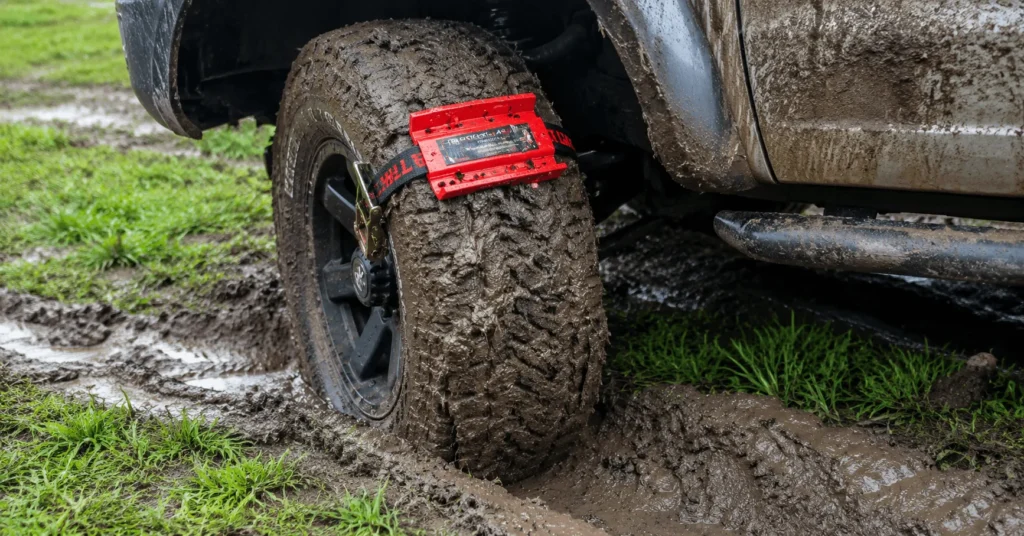
A tire mounted traction aid works differently. It attaches to the drive tire and uses the tire’s own rotation to create bite. It does not need a tree, another vehicle, or a wide board under the tire.
The TruckClaws Light Truck Kit is sized for pickups, SUVs, and small commercial trucks under 30,000 lbs GVW. That makes it a natural fit for residential yards, wet grass parking fields, rural properties, and light service trucks.
The first rule is simple: stop spinning.
Each tire rotation cuts through more root mat. Once the grass layer is destroyed, the tire is no longer fighting grass. It is fighting wet soil.
Follow this recovery sequence:
If the truck is not moving but the tires are spinning, take your foot off the throttle. Do not keep trying “one more time.” That usually makes the rut deeper.
Check each tire. Look for the drive wheel with the firmest surface nearby. On wet grass, this is often the tire closest to a driveway, gravel edge, sidewalk, or slightly higher ground.
The easiest path is often the same path you used to enter. The soil under your existing tracks has already been compacted once. A fresh path through soft turf may fail faster.
Place the traction aid on the drive tire that has the best chance to bite. The cleat should sit across the tread, perpendicular to the tire’s rolling direction. Tighten the strap firmly. A loose strap can slip quickly on wet grass.
Wet grass needs slow power. Sudden throttle can spin the tire before the cleat catches. Apply power carefully and let the tire mounted cleat do its job.
Once the truck moves, do not stop on the same soft grass. Keep rolling slowly until the vehicle reaches hardstanding, gravel, pavement, or firmer soil.
The best wet grass recovery is the one you never need.
Before driving onto a lawn or field, check these signs.
Walk the ground first. If your boot leaves a deep impression, your truck will leave a rut. If the ground feels spongy, the soil is already saturated.
Puddles near the parking area are a warning sign. If water is sitting within 20 feet of the spot, the soil below the grass may already be full of water.
Look at where other vehicles have driven. If the tracks are already two inches deep, your truck may sink too. Ruts, torn grass, and shiny mud patches are early signs of surface failure.
For service trucks, wet grass is not rare. It is part of the job.
Landscaping trucks, septic trucks, propane delivery vehicles, oil delivery trucks, moving vans, and construction service vehicles often work on or near lawns. One stuck call can cost more than the recovery gear that would have prevented the delay.
A permanent kit behind the seat makes sense for trucks that regularly enter yards, fields, rural driveways, and soft jobsites.
For heavier vehicles, this guide on self recovery gear for service and commercial trucks explains how to think about recovery tools by truck size and work use.
Outdoor weddings, festival lots, farm venues, and event fields often use grass parking or grass access roads. A loaded vendor truck stuck before setup can delay the whole job.
These trucks often operate on rural properties after rain. The vehicle is heavy, and the surface depends on the customer’s yard, not the driver’s plan.
Wet lawns are part of the work. A traction kit should be standard gear, not an afterthought.
Fuel delivery, concrete support, parts runners, and jobsite pickups often drive near soft shoulders, unfinished grades, and disturbed soil.
Personal pickups loaded with camping gear can sink in event fields after several days of rain and traffic.
Wet grass is one of the most underestimated stuck truck surfaces in America.
It does not look dramatic. It does not look like deep mud or beach sand. But once the root mat fails, a truck stuck on wet grass can sink fast and become hard to recover without the right tool.
The smart move is to read the surface before driving onto it. If the ground feels soft, if water is nearby, or if other vehicles have already left ruts, treat the grass like mud.
Stop the tires early. Choose the firmest exit path. Use controlled throttle. Carry recovery gear before the truck needs it.
Wet grass does not look dangerous until the truck is already down. That is why it deserves more respect than most drivers give it.