
Few things can ruin a day on the road faster than a semi truck stuck in mud. One minute you’re backing into a customer site, crossing a construction entrance, or parking near a loading area. The next, the drive tires are spinning, the truck isn’t moving, and every attempt to power out seems to make the situation worse.
For owner operators and fleet managers, getting stuck is more than an inconvenience. Delayed deliveries, missed appointments, recovery costs, and expensive heavy wrecker calls can turn a simple mistake into a costly problem.
The good news is that not every mud recovery requires professional towing equipment. The first few decisions made after a truck becomes stuck often determine whether the situation stays manageable or becomes a major recovery operation.
This guide explains what to do when a semi truck stuck in mud situation occurs, how to avoid costly mistakes, when a heavy wrecker becomes necessary, and how the right recovery gear can help reduce downtime and get you moving again.
A loaded tractor trailer can weigh tens of thousands of pounds. Even an empty tractor places significant pressure on a relatively small tire contact patch.
When the ground underneath those tires becomes saturated with water, loose clay, soft soil, or deep mud, traction disappears quickly. Once the drive tires begin spinning, the truck’s weight starts working against it.
Many drivers assume more power will solve the problem. In reality, traction matters far more than horsepower.
As the tires rotate against soft ground, they remove material from beneath the tread. Each rotation creates a deeper rut. Before long, the truck may be resting closer to the surface while the tires continue sinking.
This is why a tractor trailer stuck in mud can go from a minor inconvenience to a major recovery operation in just a few minutes.
Commercial trucks commonly become stuck in:
Many of these surfaces appear stable from a distance but cannot support the weight of a commercial vehicle.
The biggest mistake drivers make after finding a semi truck stuck in mud is continuing to apply throttle.
The natural reaction is to give the truck more power and try to force it forward. Unfortunately, this usually makes the recovery much harder.
Every second of wheel spin removes more soil from beneath the tire.
What begins as a shallow depression can quickly become a deep hole that traps the tire. Once that happens, recovery becomes more difficult, more expensive, and more time consuming.
Excessive wheel spin can also increase wear on:
Many of these issues are covered in our guide on common recovery mistakes:
Stop immediately if you notice:
At that point, additional throttle is rarely helpful.
Before attempting a recovery, determine exactly how stuck the truck is.
The depth of the rut often determines whether a simple self recovery is possible or whether professional assistance may be needed.
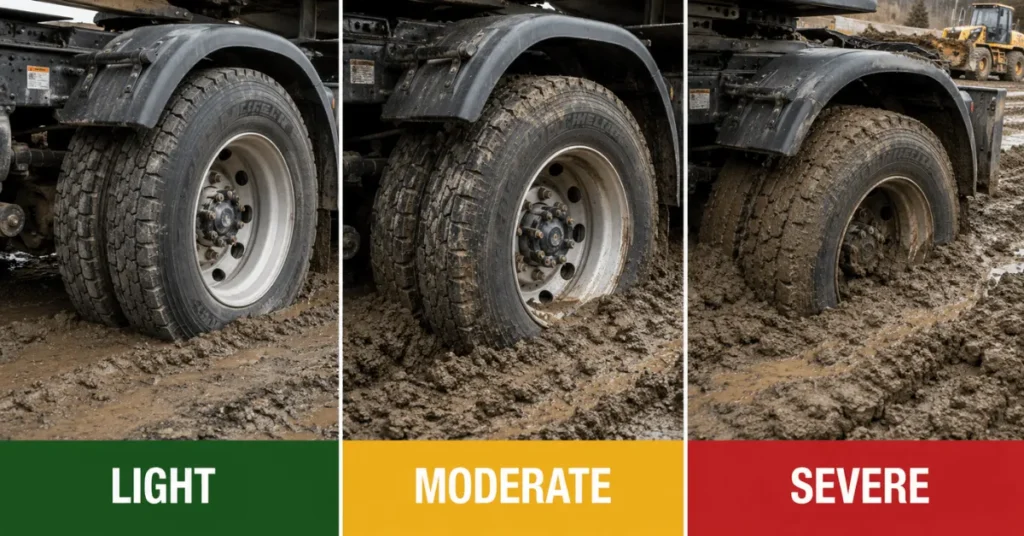
This is the best case scenario.
Signs include:
Recovery is often straightforward if traction aids are used early.
At this stage:
Drivers should avoid aggressive throttle input because further wheel spin usually makes recovery harder.
A tractor trailer stuck in mud becomes a much bigger challenge when:
This situation may require extensive preparation before any recovery attempt.
Image Placement: Semi truck stuck in mud showing different tire sink depths
Many recoveries fail because drivers focus only on creating traction while ignoring the mud physically blocking the truck’s path.
If cargo can safely be unloaded, reducing vehicle weight may improve recovery chances.
Every pound removed reduces pressure on the soft surface beneath the truck.
Removing mud directly in front of and behind the drive tires can make a significant difference.
Instead of trying to climb a mud wall, the tires can move onto a gradually prepared surface.
A set of shovel and recovery accessories can help remove packed mud, create a recovery path, and prepare the area for traction devices:
After clearing excess mud, create a firmer base using:
The goal is simple: give the tires something solid to grip.
The longer a truck remains stuck, the more difficult recovery becomes.
Every recovery attempt, every rain shower, and every hour spent settling into soft ground increases the challenge.
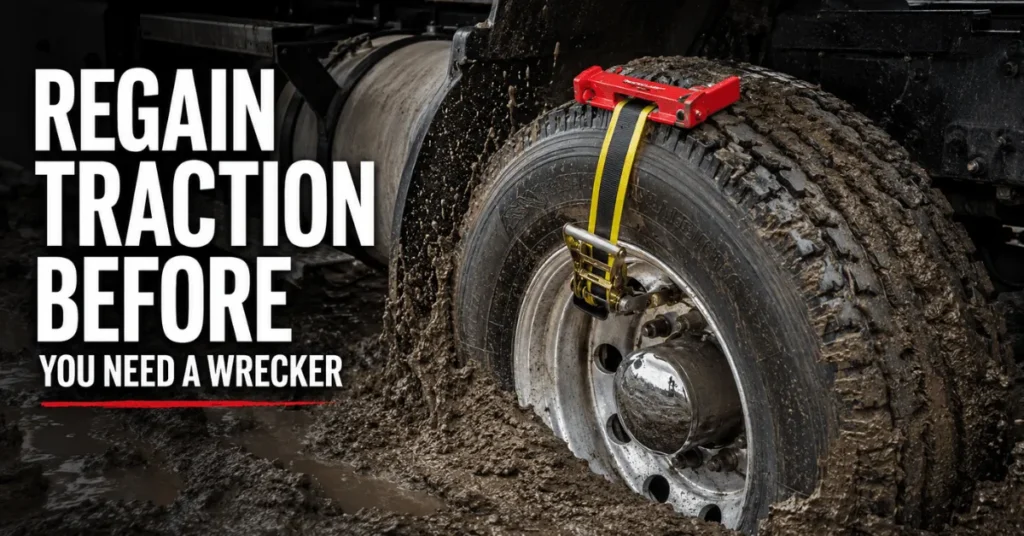
Most modern semi trucks already have enough power.
The problem is not power.
The problem is transferring that power to the ground.
When tires cannot grip the surface, additional throttle only creates more wheel spin.
Traction aids work by placing a durable gripping surface between the tire and the mud.
Instead of relying on slippery soil, the tire gains contact with a structured surface designed to provide forward movement.
A commercial traction aid like the TruckClaws Commercial Kit can often help restore grip before the truck sinks deeper:
For drivers working in construction, agriculture, utilities, and energy sectors, this can mean the difference between a short delay and a full scale recovery operation.
Image Placement: TruckClaws installed on semi truck drive tire during mud recovery
Not every recovery can be handled with traction devices and basic tools.
Sometimes calling a heavy wrecker is the safest option.
Consider a heavy wrecker if:
Drivers sometimes spend hours trying to avoid a tow bill.
That can become much more expensive if equipment damage occurs.
If conditions are becoming unsafe, stop and call for professional assistance.
One reason this topic matters so much to fleet managers and owner operators is the difference between prevention and emergency recovery.
Depending on location and recovery difficulty, a heavy wrecker cost may include:
For a detailed breakdown of heavy duty towing costs, see: A difficult mud recovery can quickly reach thousands of dollars. The tow bill is only part of the problem. A stuck truck can also create: Many fleets focus on prevention because the hidden costs often exceed the recovery bill itself. Image Placement: Heavy wrecker cost compared with commercial truck recovery gear Most commercial drivers carry tools for mechanical emergencies. Recovery equipment deserves the same attention. Quality traction aids help restore grip when tires lose contact with firm ground. For many drivers, one successful recovery can justify carrying the equipment. A compact shovel can help: A dedicated recovery shovel kit is one of the most useful pieces of equipment a driver can carry: Recoveries rarely happen in ideal conditions. Gloves and portable lights improve safety and efficiency. Checking tire pressure before and after a recovery can help identify damage or air loss before returning to the road. When a semi truck stuck in mud situation occurs, the challenge is usually not engine power. The challenge is restoring traction. The TruckClaws Commercial Kit is designed to help commercial vehicles regain grip in: For demanding recovery conditions, the TruckClaws Commercial Extreme Kit provides additional traction capability for heavy duty applications: No traction device can replace a professional recovery in every situation. However, many recoveries become expensive simply because traction was never restored early enough. The ability to regain traction quickly can reduce: Drivers interested in building a complete recovery setup should also review this guide on self recovery gear: ✓ Stop wheel spin immediately ✓ Check how deep the tires are buried ✓ Inspect the surrounding surface ✓ Clear mud around the tires ✓ Create a safe recovery path ✓ Prepare traction equipment ✓ Inspect tires for damage ✓ Check underneath for leaks ✓ Verify lights are functioning ✓ Confirm normal steering ✓ Perform a short test drive ✓ Store recovery equipment properly A semi truck stuck in mud does not automatically mean you need a heavy wrecker. Many recoveries become expensive because drivers continue spinning tires, fail to improve traction, or wait too long before taking action. The most successful recoveries usually follow the same process: stop early, assess the conditions, improve traction, use the right recovery gear, and avoid digging deeper. For owner operators and fleet managers, investing in self recovery gear is often far less expensive than paying for emergency towing, extended downtime, and missed deliveries. The best recovery is the one that gets the truck moving again before the call to a heavy wrecker becomes necessary.
https://truckclaws.com/heavy-duty-towing-costs/@@Z676Z@@@@Z677Z@@
Downtime Often Costs More
Best Recovery Gear to Keep in a Semi Truck
Traction Aids
Shovel Kit
Work Gloves and Lighting
Tire Pressure Gauge
How TruckClaws Help Commercial Trucks Regain Traction?
TruckClaws Commercial Kit
TruckClaws Commercial Extreme Kit
Reducing Dependence on Emergency Recovery
Final Checklist for Drivers and Fleet Managers
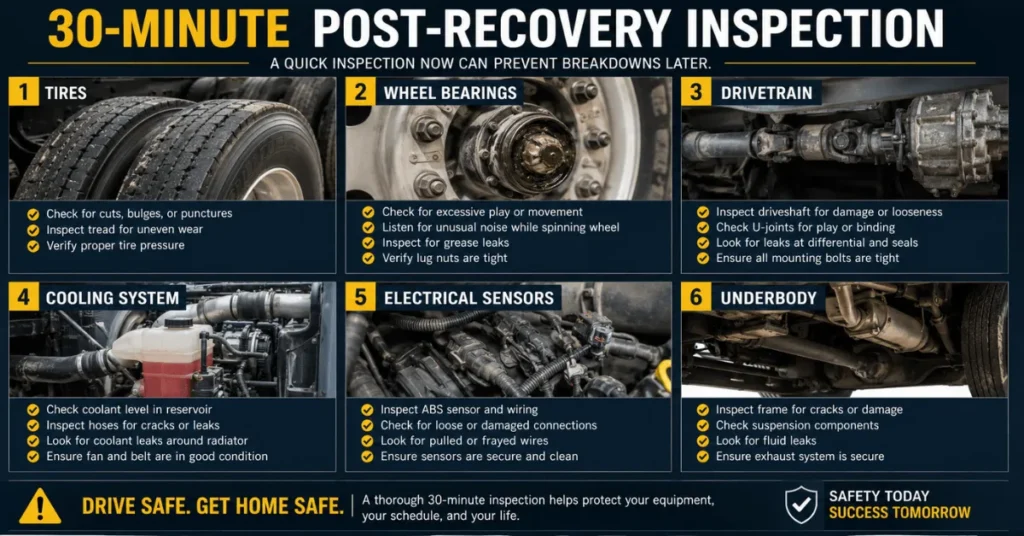
Before Attempting Recovery
Before Returning to the Road
Final Thoughts