
If you drive a Class 7 or 8 truck with standard dual tires and a GVW of 30,000 lbs or more, get the Commercial Truck Kit. If your straps take a daily beating on rough job sites, step up to the Heavy Duty Kit. If you run wide super single tires, you need the Super Single Kit, nothing else fits right. And if your routes regularly cross deep mud, thick ice, or heavy snow, the Extreme Kit with its mud and sand attachments is the one. Pickups and SUVs should look at the TruckClaws II range instead. That is the whole guide in one paragraph. The rest of this article explains why, so you buy once and buy right.
A traction aid only works when it matches your truck. The wrong kit wastes money at best. At worst, you are still stuck on a muddy job site watching the clock while a heavy duty tow bill grows. Every TruckClaws commercial kit uses the same basic idea: steel claws strap onto the tire and dig into the surface, turning wheel spin into forward push. What changes between the four kits is the strap strength, the tire type they fit, and how far they go in extreme ground. Here is each one, honestly described.
| Kit | Best for | GVW rating | Key difference |
|---|---|---|---|
| Commercial Truck Kit | Standard dual tires, highway and mixed routes | 30,000 lbs+ | The all-round commercial kit |
| Commercial Heavy Duty Kit | Trucks that work daily in punishing conditions | 30,000 lbs+ | Reinforced heavy duty straps |
| Commercial Super Single Kit | Wide super single tires | 30,000 to 80,000 lbs | Built for super single tire fitment |
| Commercial Extreme Kit | Deep mud, thick ice, heavy snow | 30,000 lbs+ | Adds mud and sand attachments |
This is the kit most commercial drivers should start with. It is built from heavy duty steel for commercial vehicles with a GVW rating of 30,000 lbs or higher, which covers Class 7 and 8 trucks, long haul rigs, construction haulers, and tow and recovery vehicles.
What is in the box: two steel claws, two ratchets, two reinforced straps, and a rugged carry bag.
Why it works: the claws strap directly onto the mounted tire. No tire removal, no special tools. You stop when traction fades, wrap each strap around the tire, set the claw over the tread, tighten the ratchet, and ease onto the throttle. The claws bite and the truck climbs out of snow, mud, sand, or wet ground.
Honest note: for very large loads, the manufacturer recommends two kits (four claws) for extra traction. If you haul at the heavy end of the scale, budget for that from the start instead of finding out on a job site.
Get this kit if: you run standard dual tires on a Class 7 or 8 truck and want reliable self-recovery without calling a tow.
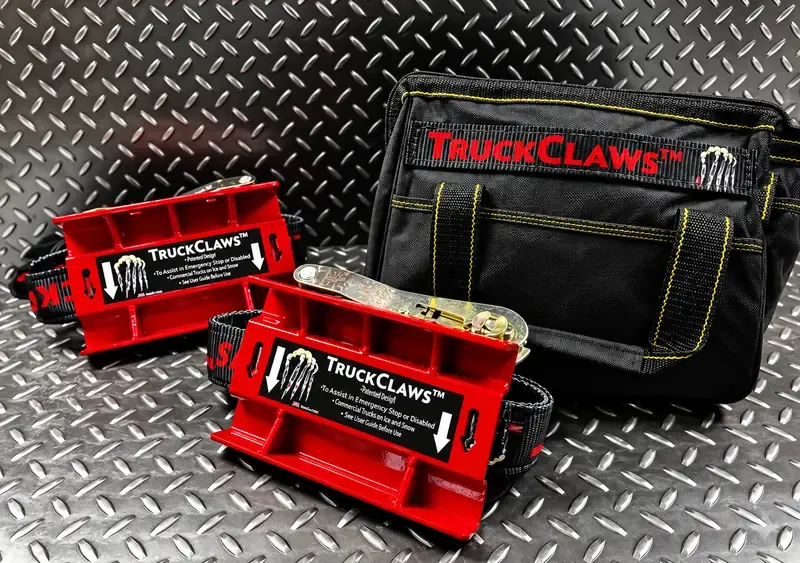
Some trucks do not just visit bad ground, they live on it. Logging trucks, mining haulers, and construction rigs cycle through mud and rough terrain every single day. That daily abuse wears out standard straps faster.
The Heavy Duty Kit answers that with reinforced heavy duty straps alongside its steel claws and ratchets, built for the punishment of constant commercial use. Everything else follows the same proven pattern: steel claws, fast install, no tire removal.
Get this kit if: your truck works rough ground daily and you want the strongest strap setup in the range. If your routes are mostly highway with occasional bad weather, the standard Truck Kit is enough and you should not pay for strength you will not use.
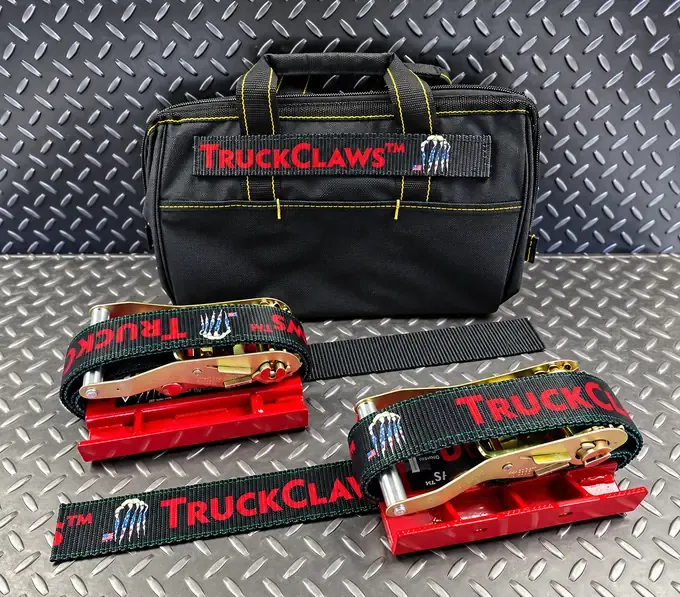
This one is about fitment, not toughness. Many modern commercial trucks run wide super single tires instead of duals. A kit shaped for dual tires will not sit right on a super single, and a poor fit means poor traction.
The Super Single Kit is engineered for exactly this tire. It is listed for heavyweight commercial trucks between 30,000 and 80,000 lbs, and it secures tightly around the tire with strong ratchets and durable straps. It also includes mud and sand attachments that bolt on with the included tool for extra bite in soft ground.
Get this kit if: your truck runs super single tires. Check your tire size and wheel setup before ordering, because weight alone does not confirm fit. If you run standard duals, this is not your kit.
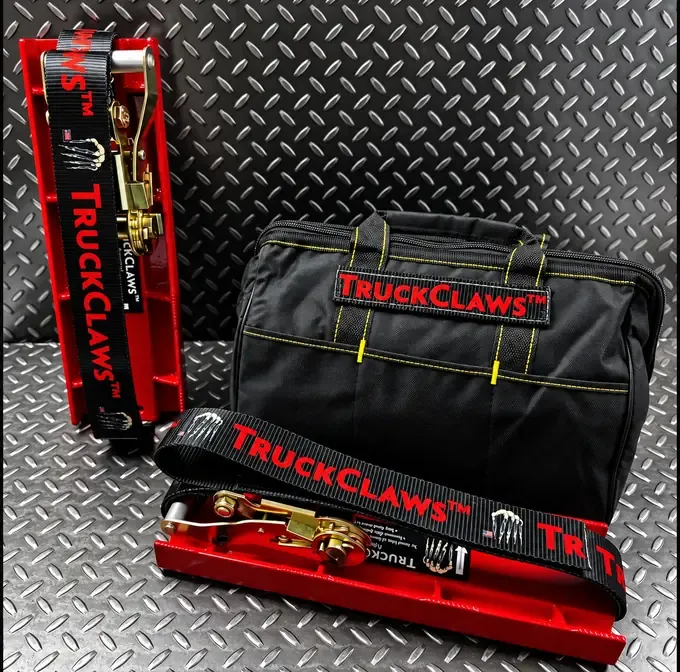
When the ground itself is the enemy, deep mud pits on construction or logging sites, thick ice, heavy snowdrifts on remote routes, the standard approach needs backup. The Extreme Kit adds dedicated mud and sand attachments to the steel traction claws.
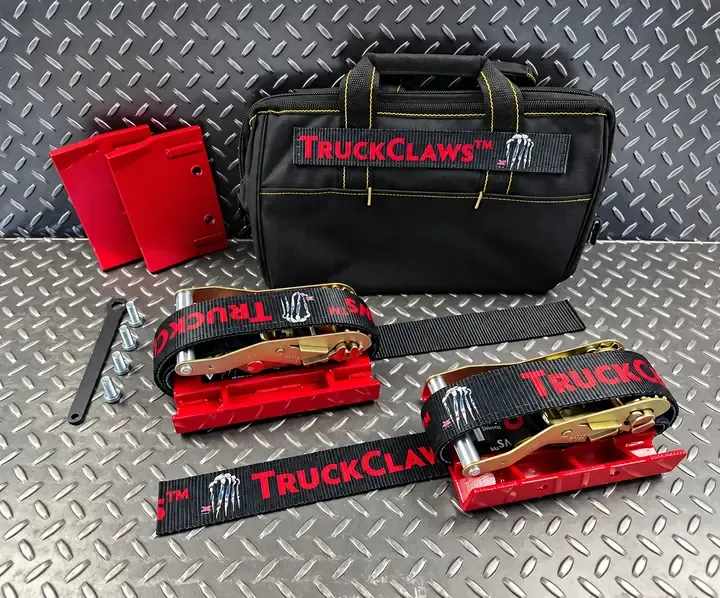
What is in the box: two steel claws, two 2 inch ratchets, two 2 inch by 48 inch straps, two 5 inch mud and sand attachments, four bolts, and an installation tool.
It is built for GVW 30,000 lbs+ commercial vehicles and aimed at drivers in construction, mining, logging, utility, and emergency services who face extreme winter weather or off road job sites regularly.
Honest note: this is a specialist tool. If your worst day is an icy highway on-ramp, the standard Truck Kit handles it. Buy the Extreme Kit when deep mud, thick ice, or heavy snow is a normal part of your week, not a rare event.
1. What is your GVW? All four kits are built for commercial vehicles rated at 30,000 lbs or more. If your truck is lighter, a pickup or an SUV, stop here and look at the TruckClaws II range. The commercial kits are not made for light vehicles.
2. What tires do you run? Wide super single tires mean the Super Single Kit, full stop. Standard dual tires mean one of the other three.
3. How bad is your ground? Occasional snow, mud, or sand on mixed routes points to the Commercial Truck Kit. Daily punishment on rough sites points to the Heavy Duty Kit. Regular deep mud, thick ice, or heavy snow points to the Extreme Kit.
Answer those three and the choice makes itself.
An honest guide says no as well as yes. Do not buy a commercial kit if:
Can I use two kits on one truck?
Yes. For very large loads, two kits (four claws) are recommended for extra traction. Follow the installation guidance for your vehicle.
Do the kits work on ice?
The steel claws dig into icy surfaces, and the Extreme Kit’s mud and sand attachments add bite in the worst conditions. Drive gently and let the claws work.
How long does installation take?
The kits are designed to install in minutes with no tire removal. Stop safely, strap the claws on, tighten the ratchets, and accelerate slowly.
Can I buy replacement straps separately?
Yes. Separate straps and ratchets kits are sold for the commercial range, so you can replace worn parts without buying new claws.
Which kit is best for fleet operators?
It depends on the fleet’s routes. Mixed highway fleets do well with the Commercial Truck Kit. Fleets on rough sites daily should consider the Heavy Duty Kit, and fleets running super singles need the Super Single Kit. Many operators keep one kit per truck so no driver is ever stuck waiting.
Most commercial drivers with standard duals should buy the Commercial Truck Kit. Daily rough-site work calls for the Heavy Duty Kit. Super single tires call for the Super Single Kit. Regular extreme ground calls for the Extreme Kit. Match the kit to your truck, your tires, and your routes, and you will have self-recovery sorted before winter or the next muddy job site arrives.