
The best traction aid for dually trucks in snow depends on the situation, not just one product.
Winter-rated tires help with daily driving, tire chains give strong grip where laws require them, and emergency traction aids like TruckClaws help when a dually truck gets stuck in deep snow or ice.
The safest setup is using the right tires and carrying a fast recovery tool for sudden traction loss.
Dually trucks face more traction problems than single-rear-wheel trucks because dual rear wheels (DRW) spread weight differently on snow. When snow is deep or packed, both rear tires can spin at the same time.
Add high torque, heavy payloads, and unplowed winter roads, and traction becomes harder to control. This is why many drivers struggle even with good tires.
Another issue is that tires alone are often not enough in real winter conditions. Even 3PMSF winter truck tires can lose grip on black ice, steep inclines, or deep powder.
Chains help in extreme weather, but they are slow to install and not always practical. That is where emergency traction aids play an important role.
In this guide, you will learn how to improve winter truck traction using the right mix of winter tires, tire chains for dually trucks, and emergency traction aids like TruckClaws.
We will explain when each tool works best and how to stay prepared for snow, ice, and winter recovery without overcomplicating things.
Dually trucks, or dual rear wheel (DRW) trucks, have two wheels on each side of the rear axle. This design is great for carrying heavy loads, but it can make rear axle traction uneven in snowy or icy conditions.
When the ground is slippery, both rear tires can spin without gripping properly, making it harder for the truck to move forward.
Whether the truck is empty or loaded also changes traction. A lightly loaded dually may struggle more because there isn’t enough weight on the rear tires to press them into the snow.
On the other hand, a heavily loaded truck may dig into deep snow, making it hard to get moving without extra help.
Wheel spin versus forward bite is another key issue. Even with good winter truck tires, the wheels may spin quickly but fail to push the truck forward.
This affects both starting traction when you begin moving and stopping traction when braking on slopes or icy roads.
Some common scenarios where dually trucks lose traction include:
Understanding these problems shows why relying only on tires is not enough. Emergency traction aids like TruckClaws or tire chains become important tools to regain control and get moving safely.
The first step to improving traction for dually trucks in snow is starting with the right winter truck tires. Good tires are your baseline traction, helping you move safely on ice, snow, and unplowed roads.
Even the best tires cannot solve every problem, but they make using tire chains or TruckClaws much easier when you need extra grip.
When picking winter tires for a dual rear wheel (DRW) truck, pay attention to:
Some of the most trusted winter tires for heavy-duty dually trucks are:
All-terrain (AT) tires usually handle snow better than mud-terrain (MT) tires. AT tires balance tread design for both ice and snow while still performing well on pavement. MT tires may dig in off-road but can slide on ice or packed snow.
Even the best winter tires have limits:
Remember: tires handle daily driving, but they are not recovery tools. When a dually truck gets stuck in deep snow or icy conditions, you need emergency traction aids like TruckClaws to get moving safely.
Tire chains for dually trucks are one of the most powerful ways to improve winter truck traction, especially in deep snow and icy conditions.
They give maximum grip when driving on mountains, highways, or areas with chain control laws.
However, chains are not always practical for every situation, so it’s important to understand when and how to use them.
Tire chains are most useful in these scenarios:
While chains are strong, they have limitations for dual rear wheel (DRW) trucks:
Chains are powerful, but they are not always the fastest or most practical option in emergencies. That’s why emergency traction aids like TruckClaws are a must-have for quick recovery when you lose traction unexpectedly.

When a dually truck loses traction in deep snow or on icy roads, emergency traction aids become the lifesaver. Among these tools, TruckClaws stand out as a fast, reliable, and easy-to-use option for self-recovery.
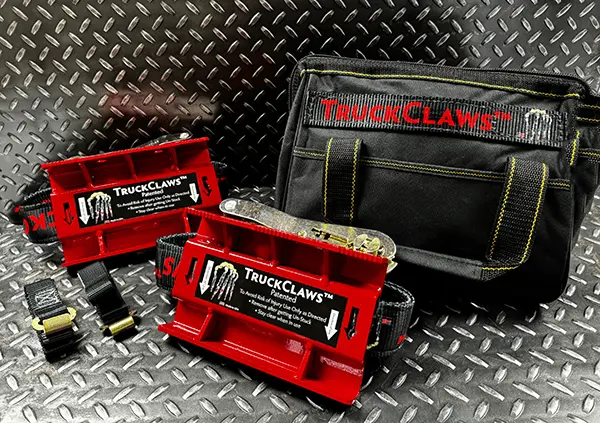
TruckClaws are tire-mounted traction systems designed for quick recovery when your truck gets stuck in snow, ice, or mud. Unlike chains, they don’t require digging or jacking. You simply attach them to the tire and gain immediate grip to move forward.
TruckClaws fill the gap between regular winter truck tires and tire chains. Even the best tires can fail in extreme conditions, and chains may take too long to install. With TruckClaws, you regain momentum fast and safely.
Besides TruckClaws, there are other traction aids for dually trucks. These can help in light or moderate snow, but they have limitations compared to tire-mounted systems.
For dually trucks, tire-mounted aids like TruckClaws are more practical. They work faster, require no digging, and can handle heavy loads and high torque better than socks or ground mats.
Many drivers wonder whether to use tire chains or traction aids like TruckClaws. The truth is, they are not competitors—they solve different problems. Choosing the right tool depends on your situation, truck type, and winter conditions.
| Situation | Best Option |
| Driving long distances in light snow | Tire Chains |
| Legal chain-control zones | Tire Chains |
| Sudden loss of traction | TruckClaws |
| Emergency self-recovery | TruckClaws |
| Mixed pavement and dirt roads | TruckClaws |
Key Takeaways:
Using the right tool in the right situation keeps your truck safe and moving efficiently in winter conditions.
Driving a dually truck in snow comes with different challenges. Knowing which tool to use in each situation can save time, protect your tires, and prevent getting stuck.
While tires provide the baseline traction, TruckClaws and tire chains offer extra help—but TruckClaws now stand out as an all-in-one solution, even for continuous driving in deep snow.
In all these scenarios, TruckClaws act as both an emergency recovery aid and a continuous driving solution.
They are easy to install, protect your tires, and handle deep snow, icy inclines, and unplowed roads, making them the most practical tool for dually trucks in winter.
When driving a dually truck in snow, it’s important to follow chain laws and DOT requirements to avoid fines and ensure safety. Even if you carry TruckClaws or other emergency traction aids, knowing the legal rules helps you plan ahead.
Some states, like California, Colorado, and Washington, have chain-control zones where tire chains for dually trucks are mandatory during certain winter conditions. Failing to comply can result in fines or being stopped until chains are installed.
While TruckClaws are excellent for recovery and even continuous driving in deep snow, they are not always recognized by law as a replacement for chains. Chains are often required by law on mountain passes or specific highways, so you may still need them for compliance.
TruckClaws and other emergency traction devices are typically allowed in situations where you get stuck unexpectedly or need self-recovery. They are a lifesaver for remote areas, deep snow starts, and icy inclines.
By understanding the rules and being prepared with TruckClaws, you can drive safely, recover quickly, and avoid legal trouble during winter trips with a dually truck.
No single tool can handle every winter driving situation for a dually truck. The smartest approach is to layer your traction solutions so you are prepared for deep snow, icy roads, and unplowed terrain.
The most prepared dually drivers don’t rely on just one solution. Combining tires, chains, and TruckClaws ensures you can drive safely, recover quickly, and handle any winter scenario without stress.
Yes, in most chain-control zones or states with winter traction laws, all rear tires on a dual rear wheel (DRW) truck must have chains installed. This ensures even rear axle traction and prevents wheel spin on icy or snowy roads.
While TruckClaws are excellent emergency traction aids and can even help with continuous driving in deep snow, they do not legally replace chains in areas where chains are required. Use TruckClaws for self-recovery, and carry chains when traveling through mandatory zones.
Emergency traction devices like TruckClaws are typically allowed for self-recovery, but they may not meet legal requirements in official chain-control zones. Always check state DOT requirements before relying on traction aids alone.
TruckClaws are the top choice for dually trucks because they:
Using TruckClaws alongside winter tires and chains creates a layered traction strategy that keeps your dually truck safe and moving in almost any winter scenario.