
Knowing what to do when truck gets stuck can be the difference between a quick recovery and a long, expensive tow call. The first mistake most drivers make is simple: they keep pressing the throttle. In mud, sand, snow, or wet grass, that reaction usually digs the tires deeper and makes the recovery harder.
The better move is slower: take your foot off the gas, set the parking brake, step out, and inspect the situation for 60 seconds before trying anything else.
That single minute is what separates a simple stuck vehicle recovery from a serious recovery problem.
Mud, sand, snow, and wet grass all react badly to a spinning tire. When the tire spins without moving the truck forward, it pushes material sideways and downward. The longer the wheel spins, the deeper the rut becomes.
After a few seconds, the tire may only be slightly buried. After 30 seconds, the truck can be sitting much lower. After a full minute of wheelspin, the axle, frame, or differential may be close to the ground, and the recovery becomes much harder.
Repeated wheelspin can also put extra stress on nearby components, brakes, driveline parts, and sensors, especially when mud, water, packed snow, or fine sand are involved.
The goal in the first 60 seconds is simple:
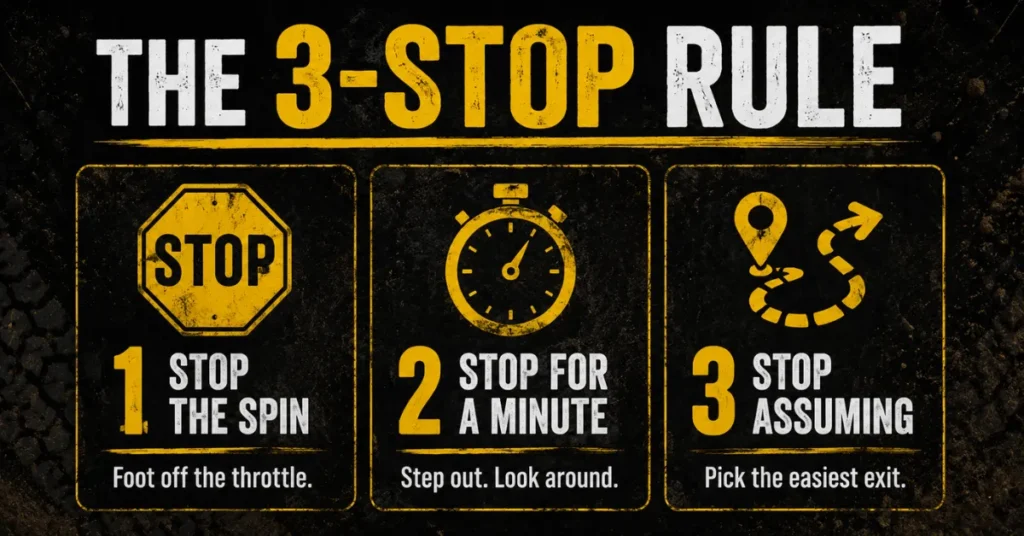
A simple way to remember the first steps is the 3 Stop Rule:
The moment the truck stops moving forward, take your foot off the throttle. If the tires are spinning but the truck is not moving, you are not recovering. You are digging.
This is the most important step when deciding what to do when truck gets stuck.
Set the parking brake, keep the vehicle stable, and step out when it is safe. Do not start digging yet. Do not grab recovery gear yet. Do not try one more throttle attempt.
Use the first minute to look around the truck and understand what actually happened.
Most drivers assume the way out is straight ahead. That is not always true.
The first minute gives you the information you need before making the next move.
Once you are outside the truck, check three things.
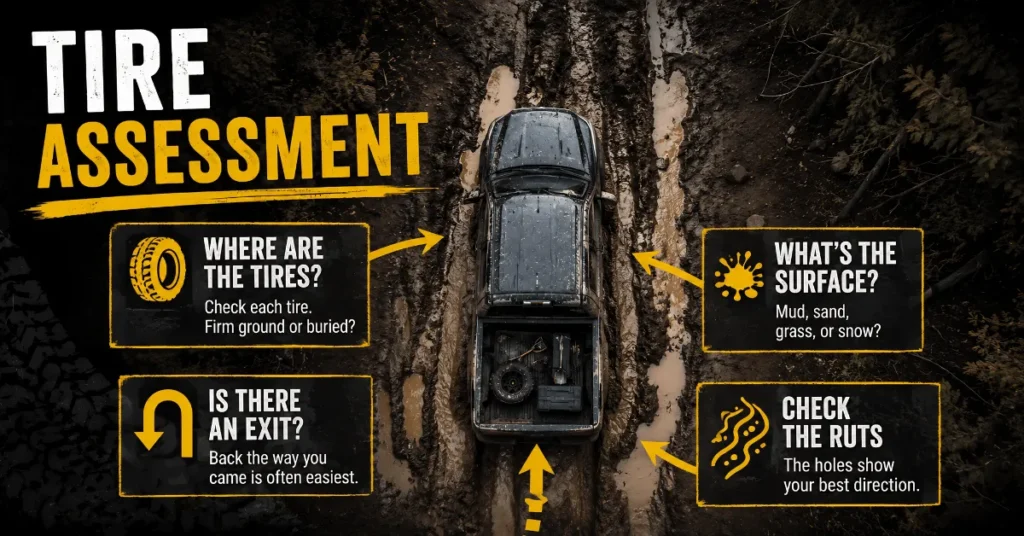
Walk around the vehicle and look at each tire.
Ask yourself:
If the hole is in front of the tire, the truck was trying to move forward when it lost grip. In that case, reversing may be easier than pushing forward. If the hole is behind the tire, forward movement may still be possible.
Touch the ground near the tire if it is safe.
Each surface needs a different recovery approach. A truck stuck in wet grass does not behave the same way as a truck stuck in deep mud.
Step back and look at where the truck needs to go.
The easiest recovery path is usually the path you already drove in on. The ground has already supported the truck once, so it may support it again.
A straight reverse recovery is usually easier than trying to turn sharply out of a rut.
Most stuck trucks have one wheel doing most of the spinning while another wheel has better traction. Finding the spinning wheel helps you decide where to dig, where to place traction, and whether a recovery aid can help.
In many 4WD trucks with open differentials, power often goes to the wheel with the least resistance. That can be the wheel sitting in the rut, exactly the wheel that cannot use the power well.
That is why 4WD does not make a truck impossible to get stuck.
If your truck has lockers, use them before making another careful recovery attempt. If your truck does not have lockers, focus on giving the spinning drive wheel something solid to bite into.
Rocking the truck between drive and reverse is a common reaction, but it is not always smart.
Rocking can sometimes help in light snow on pavement, where the tires can build small momentum. But in mud, sand, or wet grass, it often makes the rut deeper. Each forward and backward movement can push more material away from the tire.
If the truck is not gaining real movement after one or two gentle attempts, stop. More throttle is not the answer.
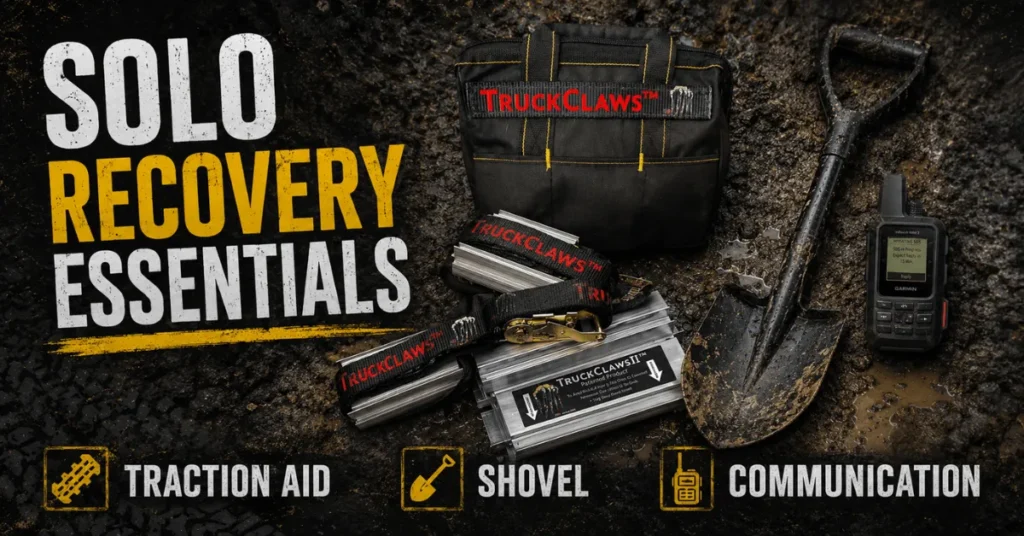
The best time to use recovery gear is before the truck is buried to the axle.
For solo drivers, the most useful recovery items are:
A tire mounted traction aid is useful because it does not need another vehicle or an anchor point. The TruckClaws Light Truck Kit is designed for pickups and SUVs under 30,000 lbs GVW and can be stored behind the seat until needed.
Use it early, before the tires dig deeper and the truck settles lower.
Some stuck situations are not worth trying to recover alone.
Stop and call for help if:
A tow bill is cheaper than vehicle damage, injury, or a dangerous recovery mistake.
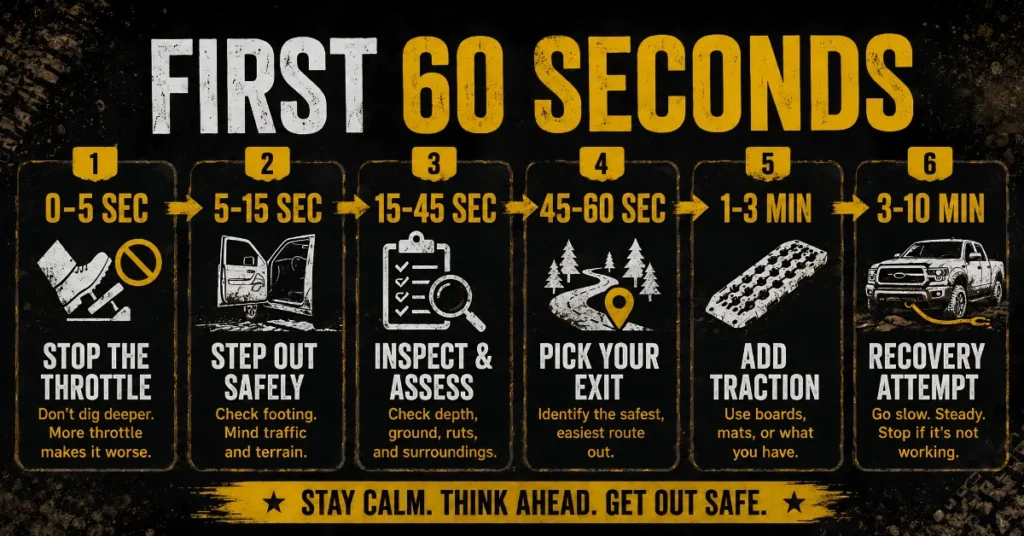
Here is the simple version:
Second 0-5:
Take your foot off the throttle. Stop the wheelspin.
Second 5-15:
Set the parking brake and step out when safe.
Second 15-45:
Walk around the truck. Check each tire, the surface, and the rut depth.
Second 45-60:
Decide whether the easiest exit is forward, backward, or not safe to attempt alone.
Minute 1-3:
If the recovery is safe, dig lightly and add traction to the correct drive wheel.
Minute 3-10:
Make one slow, controlled recovery attempt. If it fails, stop and reassess.
The answer to what to do when truck gets stuck is not “press the gas harder.” It is the opposite.
Most expensive stuck truck recoveries begin with the same mistake: the driver keeps spinning the tires for too long. The drivers who avoid that mistake are usually the ones who recover faster, safer, and with less damage.
Before your next off road trip, keep a compact recovery option in the cab. The TruckClaws Light Truck Kit gives you a way to add traction quickly without waiting for another vehicle or anchor point.
Also make sure you didn’t make the most common recovery mistakes before your next trip.