
The Service Tire Monitor System message means your Tire Pressure Monitoring System (TPMS) has a fault and can no longer check your tire pressure reliably. It is not the same as a low tire pressure warning. A solid TPMS warning light usually means a tire is low on air. A flashing light or a service message means the monitoring system itself needs attention, often a dead sensor battery, a damaged sensor, or a communication fault. Check your tire pressure manually first, then get the system checked.
The Tire Pressure Monitoring System (TPMS) is a safety system that watches the air pressure in your tires and warns you when something is wrong. When it works normally, you never think about it. When it cannot do its job, your dashboard shows a service message such as:
All of these point to the same thing: the system that watches your tires has stopped watching reliably.
This is the distinction that matters most, and most drivers mix the two up.
A solid TPMS warning light (the horseshoe-shaped icon with an exclamation mark) means one or more tires may be underinflated. The system is working fine; it is doing its job and telling you to check your air.
A flashing TPMS light (usually flashing for 60 to 90 seconds before staying on) or a Service Tire Monitor System message means the system itself has a fault. The sensors, the receiver, or the control module is not working. In this state, the truck cannot warn you about low pressure, which is why the message deserves quick attention.
Simple rule: solid light means check your tires; flashing light or service message means check the system.

The most common causes are straightforward:
Note that more than one problem can exist at once. A failed sensor can hide a genuinely low tire, which is why you should always check pressure by hand before assuming the warning is only electronic.
Here is where trucks differ from cars, and where most generic articles stop being useful.
The federal TPMS rule does not cover heavy trucks. In the United States, the TPMS mandate (Federal Motor Vehicle Safety Standard 138) applies to passenger cars, multipurpose passenger vehicles, trucks, and buses with a GVWR of 10,000 pounds or less, except vehicles with dual wheels on an axle. That means a Class 7 or 8 commercial truck was never required to have TPMS in the first place. If you drive a heavy rig, tire pressure is on you: manual checks with a gauge are your monitoring system.
Light trucks, pickups, and SUVs do have it. If your pickup or SUV shows the service message, the system described above applies directly.
Trailers are often unmonitored. Even on trucks that have TPMS, trailer tires frequently have no sensors. A long haul driver can have perfect readings on the tractor and no idea what the trailer tires are doing.
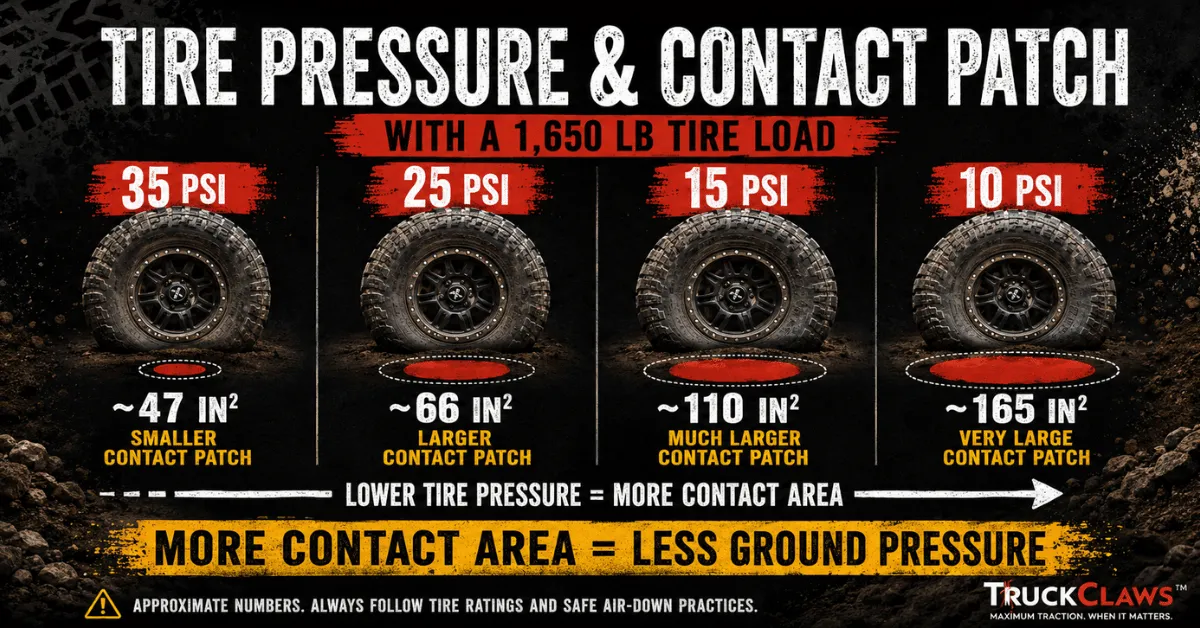
Off road makes it worse. Airing down for sand or mud, then forgetting to air back up, is a classic way to trigger warnings. And soft ground is exactly where an underinflated tire can leave you stuck. Drivers who work off pavement should treat the TPMS message as a reminder to check pressure before the ground does it for them. If low pressure has already left you stuck in mud, sand, or snow, a traction aid like TruckClaws can get you moving again while you sort the tire out.
Do not panic, but do not ignore it either:
Is it safe to drive with the Service Tire Monitor message on?
Short trips at moderate speed are usually fine, but you are driving without a working pressure warning. Check your tires manually and get the system fixed soon.
Will the message go away on its own?
Sometimes a temporary glitch clears after a restart. If it stays on, something genuinely needs repair or a relearn.
Does cold weather cause it?
Cold air lowers tire pressure, which triggers the low pressure light. But cold alone does not cause a service message; that points to a sensor or system fault.
How is this different from the low tire pressure light?
The low pressure light means the system works and found low air. The service message means the system itself is broken and cannot check at all.
Do I need special tools to diagnose it?
A tire pressure gauge handles the manual check. Reading sensor faults usually needs an OBD II scanner or a shop visit.
Service Tire Monitor System means your tire pressure watchdog has stopped working, not that a tire is necessarily flat. Check your air pressure by hand first, then fix the system fault. And if you drive a heavy commercial truck, remember the federal TPMS rule was never written for your rig, so the gauge in your glove box matters more than any dashboard light.